How We Handle 8 Common Allergens in Our Kitchen
Learn how Flavory Food manages the 8 priority allergens in our Vancouver commercial kitchen. Cross-contamination protocols, labeling practices, and what we can and cannot guarantee.
Food allergies affect roughly 2.5 million Canadians, and children experience higher allergy rates than adults[1]. When you're running a catering operation that delivers to kindergartens, school programs, and family homes across Greater Vancouver, that statistic stops being abstract fast. One miscommunication about a peanut ingredient, one shared cutting board that wasn't sanitized between batches, and you're dealing with a medical emergency in a classroom of four-year-olds.
I want to be upfront about two things before we get into the specifics. First: Flavory Food takes allergen management seriously, and I'll walk you through exactly how our kitchen operates — the protocols, the equipment separation, the labeling, the communication systems. Second: I will not promise you a completely allergen-free environment. We operate a commercial kitchen that processes all eight priority allergens on a daily basis. What I can promise is a documented, disciplined system that minimizes cross-contact risk and communicates clearly about what's in every meal that leaves our door.
That honesty matters more than a marketing claim. Parents sending their children to one of the five kindergartens we serve across Vancouver deserve to know what our kitchen can do — and where our limits are. Here's the full picture.
Summary: Food allergies affect 2.5 million Canadians, with children at higher rates. Flavory Food operates documented allergen management protocols across our Vancouver commercial kitchen, but we are transparent that we cannot guarantee a completely allergen-free environment. Parents and school administrators get full visibility into our systems, limitations, and communication procedures.
The 8 Priority Allergens: What We're Managing
Health Canada identifies eight priority food allergens that account for the vast majority of severe allergic reactions in Canada[2]. Every one of these passes through our kitchen on a regular basis because they're fundamental to authentic Asian cuisine. That's not a problem we can engineer away — it's a reality we manage with discipline.
Here's what we're working with and where each allergen shows up in our menu rotation:
| Allergen | Common Menu Applications | Prevalence in Our Kitchen |
|---|---|---|
| Milk | Cream-based sauces, certain desserts, butter in baking | Moderate — used in select dishes |
| Eggs | Egg fried rice, egg drop soup, batter coatings, baked goods | High — daily use across multiple dishes |
| Fish | Steamed fish, fish sauce (foundational condiment) | High — fish sauce is in many Asian sauces |
| Shellfish | Shrimp dishes, oyster sauce | Moderate — shellfish dishes and oyster sauce are staples |
| Tree nuts | Cashew chicken, almond garnishes, sesame-walnut desserts | Moderate — used in specific dishes |
| Peanuts | Kung pao preparations, peanut sauce, garnishes | Moderate — appears in targeted recipes |
| Wheat | Soy sauce, noodle dishes, batter coatings, dumpling wrappers | High — wheat-containing soy sauce is ubiquitous |
| Soy | Soy sauce, tofu, edamame, miso-based preparations | Very high — foundational to Asian cooking |
I'll be direct: soy and wheat are the hardest allergens to isolate in an Asian kitchen. Standard soy sauce contains both. It's in marinades, stir-fry sauces, and dipping condiments. When a parent tells us their child has a soy allergy, that doesn't mean we simply pull one ingredient — it means we rebuild the entire flavour profile of that meal from scratch using tamari or coconut aminos alternatives, and we prep it on sanitized surfaces that haven't touched soy-containing products that shift.
Fish sauce presents a similar challenge. It's invisible in finished dishes but foundational to dozens of our recipes. A parent might not realize their child's meal contains fish protein unless we label it explicitly — which is exactly why we do.
Summary: Health Canada's 8 priority allergens — milk, eggs, fish, shellfish, tree nuts, peanuts, wheat, and soy — are all present in our kitchen daily. Soy and wheat are the hardest to isolate in Asian cuisine because soy sauce contains both and appears in dozens of recipes. We rebuild entire flavour profiles from scratch when accommodating these allergies rather than simply removing one ingredient.
How Our Kitchen Prevents Cross-Contamination
Cross-contamination is where allergen management either works or fails. Everything I'm about to describe is a daily discipline, not a policy binder collecting dust. Here's the exact system Flavory Food runs every shift.
1. Temporal Separation for Allergen-Free Meals
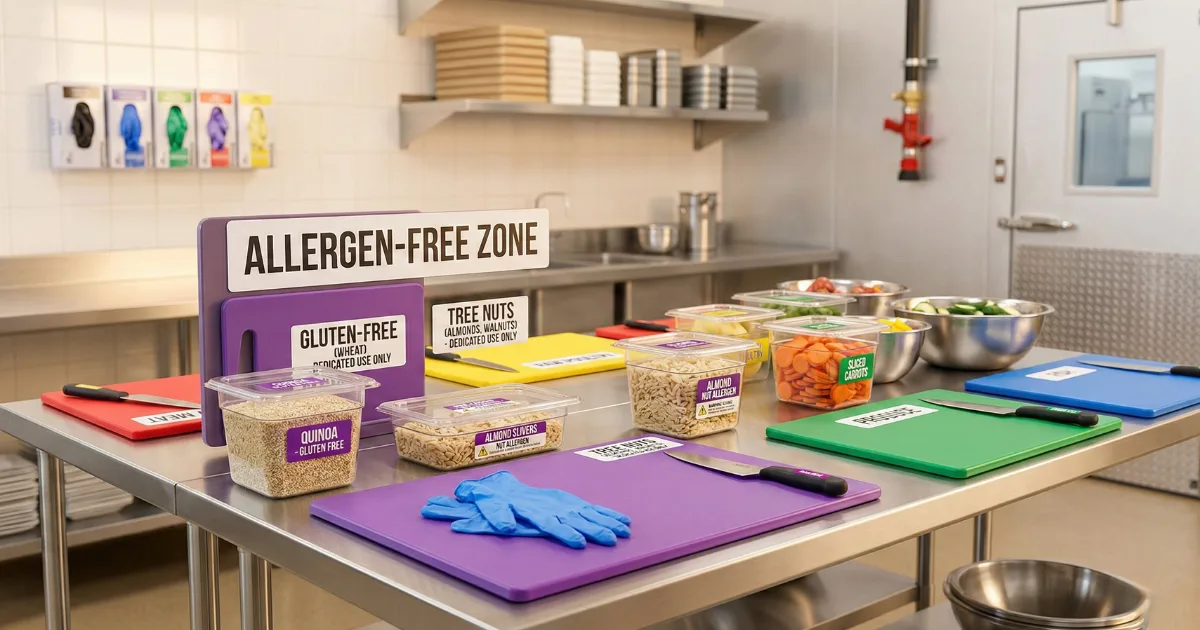
When we have orders flagged for specific allergen restrictions — which happens daily for the kindergarten contracts — those meals get prepped first, before the general production line fires up. This means allergen-free meals are assembled on clean surfaces that haven't been exposed to the day's allergen-containing ingredients. It's the simplest and most reliable separation method we've found.
2. Dedicated Equipment
We maintain a separate set of colour-coded cutting boards, knives, mixing bowls, and utensils designated exclusively for allergen-free preparation. These items are stored in a marked section of the kitchen and never enter the general equipment rotation. After every use, they go through a full wash-rinse-sanitize cycle — not a quick wipe, but the three-compartment sink protocol that Vancouver Coastal Health requires.
3. Physical Workspace Separation
Our allergen-free prep station is positioned at the far end of the kitchen line, physically distanced from the wok stations where peanut oil, soy sauce, and shellfish-based sauces are being used. In a commercial kitchen pushing out hundreds of meals, airborne particles and splatter are real vectors. That physical distance matters.
4. Staff Protocol
Every team member working the allergen-free station changes gloves and aprons before handling those orders. Hands get washed — full 20-second soap-and-water wash — between switching from general production to allergen-free work. We enforce this even during the morning rush when the pressure to move faster is intense. Shortcuts here are non-negotiable fireable offences.
5. Ingredient Verification
Before prep begins on any allergen-flagged order, the prep cook verifies every single ingredient against the allergen restriction. We read labels every time, even on products we've used for months. Suppliers change formulations without warning. I've caught a supposedly nut-free sesame paste that had added cashew oil after a supplier reformulation. That kind of catch only happens when you read the label every single time.
Summary: Cross-contamination prevention uses five layers: temporal separation (allergen-free meals prepped first on clean surfaces), dedicated colour-coded equipment, physical workspace distance from allergen-heavy stations, strict staff hygiene protocols between tasks, and ingredient verification on every batch regardless of familiarity with the product.
Labeling: What Goes on Every Container
Every meal that leaves our kitchen carries a label listing all allergens present in that specific dish. This isn't optional, and it isn't abbreviated. Here's exactly what each label includes:
- Full dish name — no shorthand or codes
- Complete ingredient list — every component, including sub-ingredients in sauces and marinades
- Priority allergen callouts — bolded and set apart so a parent or daycare staff member can identify them at a glance
- "May contain" advisory — for allergens processed in the same kitchen but not intentionally included in that dish
- Date of preparation — confirming same-day freshness
That "may contain" line is the one I get the most questions about from parents. Here's why it's there: we process all eight priority allergens in our facility. Even with temporal separation, dedicated equipment, and sanitized surfaces, I cannot guarantee zero trace contamination across every meal on every day. The "may contain" advisory is how we communicate that residual risk honestly. Some families with mild sensitivities are comfortable with that level of control. Families managing severe anaphylaxis-level allergies may need a dedicated allergen-free facility — and I will tell them that directly rather than overstate our capability.
This labeling standard exceeds what Vancouver Coastal Health's food safety guidelines require for prepared meal delivery, but after years of serving kindergartens and families across Metro Vancouver, I've learned that parents need more information, not less, to make safe decisions for their children.
Summary: Every meal is labeled with full dish name, complete ingredient list, bolded priority allergen callouts, "may contain" advisory for shared-facility risk, and preparation date. The "may contain" statement exists because we process all 8 allergens daily and cannot guarantee zero trace contamination — families with severe anaphylaxis risk may need a dedicated allergen-free facility.
What We Can and Cannot Guarantee
This is the section most catering companies skip, and it's the most important one.
What We CAN Guarantee:
- Every allergen-flagged order follows documented cross-contamination prevention protocols — temporal separation, dedicated equipment, sanitized surfaces, verified ingredients.
- Every meal is labeled with complete allergen information, including "may contain" advisories.
- Every staff member handling food holds current FOODSAFE Level 1 certification and has completed our internal allergen awareness training.
- Every allergen restriction communicated to us is logged in our order system and flagged through every stage of production — prep, cooking, assembly, and packaging.
- If we cannot safely accommodate a specific allergen restriction for a particular dish, we will tell you. We'd rather decline an order than deliver a false sense of safety.
What We CANNOT Guarantee:
- A completely allergen-free environment. Our kitchen processes all eight priority allergens daily. Trace amounts may be present on shared surfaces, in the air near cooking stations, or through incidental contact during a high-volume production run.
- Safety for individuals with extreme airborne allergen sensitivity. If your child reacts to being in the same room as peanuts, our facility is not the right fit. I say this not to turn away business, but because your child's safety is more important than our revenue.
- That supplier ingredient formulations will never change without our knowledge. We verify labels constantly, but there is always a window of risk between a supplier reformulation and our detection of it.
This transparency isn't weakness — it's the baseline of honest food service. Any caterer who tells you they can guarantee a fully allergen-free meal from a multi-allergen kitchen is either misleading you or doesn't understand the risks involved.
Summary: Flavory Food guarantees documented protocols, complete labeling, trained staff, and order-level allergen tracking. We cannot guarantee a completely allergen-free environment, safety for extreme airborne sensitivities, or immunity from undetected supplier reformulations. Any caterer promising zero allergen risk from a multi-allergen kitchen is overstating their capability.
Communicating with Schools and Daycares
We currently serve five kindergarten locations across Vancouver, and each one has different internal protocols for managing children's food allergies. Our communication system is built to work with all of them, not to override their processes.
Before the First Delivery:
- We meet with the daycare director or kitchen coordinator to review their existing allergy management policies.
- We collect a complete allergen profile for every child enrolled in the meal program — provided by parents, verified by the centre's administration.
- We build a per-child allergen restriction record in our order system. This record travels with every order from the moment it's placed through prep, assembly, labeling, and delivery.
For Every Delivery:
- Meals for children with allergen restrictions are packed in separate, clearly marked containers — distinct from the general batch.
- Labels on allergen-restricted meals include the child's identifier (first name or code, depending on the centre's privacy protocol) alongside the allergen information.
- A delivery manifest accompanies every order listing which meals have allergen modifications and what those modifications are.
Ongoing Communication:
- Parents can update their child's allergen profile at any time through the daycare coordinator or directly through our ordering system.
- If we change a supplier, ingredient source, or recipe that affects allergen content, we notify affected daycare partners before the next delivery — not after.
- We run a quarterly review with each kindergarten partner to assess whether our protocols are meeting their needs and to incorporate any changes to enrolled children's allergy profiles.
This system works because it's redundant on purpose. If the label gets separated from the container, the manifest still identifies the meal. If the manifest is missing, the label still carries full allergen data. If a daycare staff member is unsure about any aspect, they can call us directly during delivery hours and get an immediate answer.
For school programs serving older children — where we supply group meal boxes for field trips and summer camps — the communication is similar but routes through the school administrator rather than individual parent profiles. We require the school to provide a consolidated allergen list at least 48 hours before the event. Last-minute allergen additions for groups of 20 or more create genuine safety risks because they compress the time available for ingredient verification and separate prep staging.
Summary: Five kindergarten contracts each have unique allergy protocols. Our system collects per-child allergen profiles, packs restricted meals in separate marked containers with child identifiers, includes delivery manifests listing all modifications, and maintains redundant identification so safety information survives if any single component is missing. Quarterly reviews ensure protocols stay current.
Vancouver Coastal Health Requirements and How We Exceed Them
Operating a commercial kitchen in Metro Vancouver means meeting Vancouver Coastal Health (VCH) and Fraser Health standards for food safety, which include allergen management as a component of broader food handling requirements[3]. Here's where we align and where we go further.
VCH Baseline Requirements:
- FOODSAFE Level 1 certification for all food handlers
- Licensed commercial kitchen with regular health inspections
- Proper food storage, temperature control, and sanitation protocols
- Allergen awareness as part of general food safety training
Where Flavory Food Exceeds the Baseline:
- Dedicated allergen-free equipment set — not required by regulation, but essential for meaningful cross-contact prevention
- Temporal separation protocols — prepping allergen-free meals first, before general production, is our internal standard, not a regulatory mandate
- Per-child allergen tracking for institutional clients — VCH doesn't require individual-level tracking for meal delivery to daycares, but we do it because the risk profile demands it
- Proactive supplier change notifications — no regulation requires us to notify clients before an ingredient source changes, but we do it because a silent reformulation is one of the most dangerous gaps in allergen management
- "May contain" advisory labeling — Canadian labeling regulations apply to pre-packaged foods sold at retail, not to catered meals delivered to institutions. We apply the advisory voluntarily because families deserve the same transparency from their caterer that they expect from a grocery store product
I'll be honest: some of these measures add cost and complexity. Maintaining a dedicated allergen equipment set means buying duplicate tools. Temporal separation means starting allergen-free prep earlier, which extends the morning shift. Per-child tracking requires order management systems that smaller caterers don't invest in. But after years of serving families and kindergartens across Vancouver, I've concluded that these aren't extras — they're the minimum for responsible service to children with food allergies.
Summary: Vancouver Coastal Health requires FOODSAFE certification, licensed kitchens, and allergen awareness training as baseline. Flavory Food exceeds these with dedicated allergen equipment, temporal separation protocols, per-child tracking for daycares, proactive supplier change notifications, and voluntary "may contain" labeling — measures that add cost but represent the minimum responsible standard for serving children.
What Parents Should Do on Their End
Allergen management is a shared responsibility. Our kitchen protocols only work if parents communicate clearly and completely. Here's what I need from you:
- Declare all known allergies at enrollment. Don't assume the daycare passed along your child's medical information to the caterer. Verify directly that Flavory Food has your child's allergen profile on file.
- Specify the severity level. There's a meaningful operational difference between "my child gets hives from eggs" and "my child carries an EpiPen for peanut anaphylaxis." Both get full protocol treatment, but severity context helps us assess whether our shared-kitchen environment is appropriate for your child.
- Update us immediately when anything changes. Children can develop new allergies or outgrow existing ones. If your allergist updates your child's profile, we need to know before the next delivery, not at the next quarterly review.
- Read our labels when meals arrive at home. Even with our multi-layered system, the final verification is yours. Check the allergen callouts on every container before serving. This isn't about distrusting our kitchen — it's about adding one more layer of safety for your child.
- Ask questions. If you don't understand our "may contain" advisory, ask. If you want to know which specific soy sauce brand we use and whether it contains wheat, ask. We'd rather spend ten minutes on the phone walking you through our ingredient sources than have you guess.
This partnership matters more than any single protocol. The safest allergen management system in the world fails if the information feeding into it is incomplete.
Summary: Parents must declare all allergies directly to us (don't assume the daycare relayed it), specify severity levels so we can assess shared-kitchen appropriateness, update profiles immediately when allergist recommendations change, verify labels when meals arrive, and ask questions about any ingredient or advisory they don't understand.
Emergency Response: When Things Go Wrong
Despite every protocol, the possibility of an allergic reaction exists. Here's what our team is prepared to do:
- Immediate notification. If a daycare or parent reports a suspected allergic reaction connected to one of our meals, we escalate internally within minutes. The kitchen manager pulls all records for that specific meal — ingredient logs, prep station assignments, label verification — and makes them available.
- Batch investigation. We trace backward through the entire production chain for the flagged meal: which ingredients were used, which staff prepared it, which equipment was involved, whether any deviation from allergen protocols occurred.
- Client communication. Within 24 hours of any reported incident, we provide the affected family and daycare with a written summary of our investigation findings and any corrective actions taken.
- Protocol review. Every incident — confirmed or suspected — triggers a full review of our allergen management procedures. If a gap is identified, we close it before the next production day.
We've been fortunate: in our years of serving kindergarten programs across Vancouver, we have not had a confirmed allergic reaction caused by our meals. But I don't attribute that to luck. I attribute it to the system working — and to the fact that we've turned down orders when we determined our facility couldn't safely accommodate a child's specific allergy profile. Saying "we can't do this safely" is the most responsible thing a caterer can do in those situations.
Frequently Asked Questions
Can Flavory Food prepare completely allergen-free meals?
We prepare meals free of specific allergens upon request — for example, a meal with no peanuts, no tree nuts, and no soy. However, because our commercial kitchen processes all eight priority allergens daily, we cannot guarantee zero trace contamination. Every allergen-restricted meal follows our temporal separation protocol (prepped first on clean surfaces), uses dedicated equipment, and carries a "may contain" advisory on the label. For children with extreme airborne allergen sensitivity, we recommend discussing your child's specific needs with us so we can honestly assess whether our facility is appropriate.
How do you handle allergen management for kindergarten meal programs?
We collect a per-child allergen profile before service begins, entered by parents and verified through the daycare coordinator. Each child's restrictions are flagged in our order system and followed through prep, cooking, assembly, and labeling. Allergen-restricted meals are packed in separately marked containers with the child's identifier and a delivery manifest listing all modifications. We run quarterly reviews with each kindergarten partner and notify them proactively if any supplier or ingredient change affects allergen content.
What happens if my child has a reaction to one of your meals?
We take every report seriously. Upon notification, our kitchen manager immediately pulls all production records for the flagged meal — ingredient logs, prep station assignments, equipment used, and label verification. We trace the full production chain, and within 24 hours provide the family and daycare with a written investigation summary and any corrective actions. Every incident, confirmed or suspected, triggers a full review of our allergen protocols. If a gap is found, we close it before the next production day.
Do you use separate equipment for allergen-free meal preparation?
Yes. We maintain a dedicated set of colour-coded cutting boards, knives, mixing bowls, and utensils used exclusively for allergen-free orders. These are stored separately and never enter the general equipment rotation. After every use, they go through a complete wash-rinse-sanitize cycle using our three-compartment sink system. Our allergen-free prep station is also physically positioned away from wok stations where peanut oil, soy sauce, and shellfish sauces are used, reducing airborne cross-contact risk.
How do I communicate my child's allergies to Flavory Food?
Start by declaring all known allergies when enrolling in a meal program — through your daycare coordinator or directly through our ordering system. Specify the severity level, as this helps us assess whether our shared-kitchen environment is appropriate. Update us immediately if your child's allergist changes any recommendations. We also encourage parents to read labels on every container when meals arrive and to call us with any questions about specific ingredients, brands, or our "may contain" advisories. Clear, complete communication from parents is the essential first layer that makes our kitchen protocols effective.
Experience Our Allergen Management in Person
The best way to understand how Flavory Food handles allergen safety is to see our kitchen protocols firsthand. Book a complimentary tasting session where we'll walk you through our prep separation, labeling system, and ingredient sourcing — and you'll taste the food your family or daycare program would receive.
References
[1] Food Allergy Canada, "Food Allergy Facts and Statistics," 2024. Approximately 2.5 million Canadians report food allergies, with children experiencing higher rates than adults. https://foodallergycanada.ca/food-allergy-basics/food-allergy-facts-and-statistics/
[2] Health Canada, "Priority Food Allergens," 2024. Health Canada identifies priority food allergens responsible for the majority of severe allergic reactions in Canada, including milk, eggs, fish, crustaceans and shellfish, tree nuts, peanuts, wheat and triticale, soy, sesame, and mustard. https://www.canada.ca/en/health-canada/services/food-nutrition/food-safety/food-allergies-intolerances/food-allergies.html
[3] Vancouver Coastal Health, "Food Safety," 2026. Food premises inspection and licensing requirements for commercial kitchens operating in the Vancouver Coastal Health region. https://www.vch.ca/en/health-topics/food-safety
Related Articles
Vegetarian and Vegan Asian Meals: Our Plant-Based Menu
Explore The Storm Cafe's vegetarian and vegan Asian menu: tofu, tempeh, mushroom dishes, and veggie
Vancouver School Lunch Delivery: Coverage Map and Zones
Flavory Food's school lunch delivery coverage across Greater Vancouver. Zone-by-zone guide with driv
Same-Day Order Changes: Our Flexibility Policy Explained
Flavory Food explains our same-day order change policy for Vancouver families, kindergartens, and sc
Want to taste our meals?
Book a free tasting and let our fresh ingredients speak for themselves.
Free Tasting