What School Administrators Need Before Hiring a Caterer
A complete checklist for Vancouver school administrators hiring a caterer. Covers BC food safety regulations, contract essentials, allergen management, and how to evaluate catering providers for kindergarten and K-12 programs.

Canada was the only G7 country without a national school food program until 2024, when the federal government committed $1 billion over five years to expand school meal access nationwide[1]. For BC school administrators, that funding changes the game — but it also raises the stakes. The caterer you choose will directly determine whether students get nutritious, safe, and culturally appropriate meals on every school day.
After years of delivering 500+ meals daily to schools and corporate clients across six Greater Vancouver cities, Flavory Food has built the allergen management systems, BC food safety certifications, and institutional-scale reliability that administrators actually need when feeding students.
Hiring a school caterer goes well beyond comparing menus and prices. Here's the reality of what you need to evaluate — and the order you should evaluate it in:
Confirm BC-specific licensing and food safety certification. Your caterer must hold current credentials under BC regulations. This is non-negotiable and should be the first document you request — before any menu discussion happens.
Assess allergen management protocols in detail. Ask exactly how the caterer handles cross-contamination, labeling, and communication with school staff when allergens are present. A vague answer here is a disqualifying answer.
Evaluate nutritional standards against your district's requirements. From what I've seen supplying Burnaby-area schools and offices, the strong local preference runs toward lower oil and lower sodium. Your caterer should already be cooking this way, not adjusting reluctantly after you ask.
Review the contract structure for institutional protection. The contract must protect both students and your school. Look for clear terms on delivery windows, substitution policies, penalty clauses for missed or late deliveries, and termination conditions.
Verify delivery logistics and reliability under real Vancouver conditions. This is where many caterers fall short. A caterer promising noon delivery to a Richmond school needs to account for the brutal 11:45 AM–1:15 PM traffic congestion in that area — we build in a minimum 20-minute buffer for Richmond midday runs, and that's after years of route optimization. During Vancouver's rainy season from October through April, you also need a caterer whose equipment actually keeps food safe and hot in wet conditions. We've tested four different insulated delivery bags specifically to maintain food above 65°C for 90 minutes in rain — that's the kind of operational detail that separates a reliable school caterer from one that delivers lukewarm food on a wet November Tuesday.
Require adequate lead time for large-scale orders. For any event or special meal serving 50 or more students, insist on a minimum 48-hour menu confirmation window. Build this into the contract so it's a mutual obligation, not a courtesy.
This guide walks through each of these areas based on current BC regulations and the operational best practices we've developed feeding Greater Vancouver schools and institutions year-round.
Summary: School administrators must verify five critical areas before signing contracts: current BC food safety certification from regional health authorities, documented allergen management protocols with emergency procedures, nutritional compliance with BC School Meal Program guidelines, comprehensive liability insurance coverage, and proven scalability to handle daily volume fluctuations plus special events across Metro Vancouver's delivery challenges.
Quick Answer: What Do School Administrators Need Before Hiring a Caterer?
Before signing any catering contract, school administrators must verify five critical areas: BC food safety certification, allergen management protocols, nutritional compliance with the BC School Meal Program Handbook, liability insurance coverage, and scalability to handle daily volume plus special events[2][3].
Here's how I'd break this down after years of working with institutional clients across Metro Vancouver:
The Five Verification Areas — In Order of Priority
- BC food safety certification — Confirm the caterer holds a valid FOODSAFE Level 1 (minimum) and that their commissary kitchen has a current health authority operating permit. Ask to see both documents. Don't take someone's word for it.
- Allergen management protocols — Request their written allergen policy. You want specifics: how they handle nut-free prep, cross-contamination prevention, and ingredient traceability. A caterer who can't hand you a documented protocol on the spot is a caterer who doesn't have one.
- Nutritional compliance with the BC School Meal Program Handbook — Schools in this province operate under clear nutritional guidelines. Your caterer needs to demonstrate they can build menus within those parameters, not retrofit their regular corporate lunch menu. Working with Burnaby-area offices taught me that clients increasingly demand lower oil, lower sodium options — school programs take that even further.
- Liability insurance coverage — Require proof of commercial general liability insurance. For school contracts, $2M minimum coverage is standard. Make sure the policy specifically covers food service operations.
- Scalability to handle daily volume plus special events — A caterer might nail a one-time 30-person lunch but collapse at 150 students five days a week plus a year-end celebration. Ask about their production capacity, delivery fleet, and backup plans.
The Biggest Mistake I See Administrators Make
Evaluating caterers primarily on price. According to industry procurement guidelines, these factors should carry equal or greater weight in your scoring[4]:
- Food quality and freshness
- Logistics reliability — This is huge in Greater Vancouver. Getting hot food from a Richmond kitchen to a Vancouver school during the 11:45 AM to 1:15 PM lunch window means fighting some of the worst midday congestion in Metro Van. If your caterer doesn't build in at least a 20-minute buffer for Richmond routes, food arrives late or lukewarm. And from October through April, rain is a constant — we tested four different insulated delivery bags before finding setups that keep food above 65°C for 90 minutes in wet conditions. That kind of detail separates a reliable operation from one that shows up with soggy, cooled-down trays.
- Verified customer reviews and references
- Documented catering experience with similar institutions
- Safety compliance track record
Flavory Food addresses all five verification areas through daily fresh preparation, six-city delivery coverage across Metro Vancouver, documented allergen protocols, and a 4.9-star client satisfaction rating.
The BC Regulatory Landscape for School Catering
Provincial Food Safety Requirements
BC's food safety framework for schools and childcare facilities is governed by multiple overlapping regulations that caterers must comply with simultaneously, as detailed in the BC Centre for Disease Control's Food Premises Guidelines for Food Service Operations[3][5].
Four separate regulatory layers apply the moment you cater to a school or childcare facility in BC. Miss one, and you can lose the contract — or worse, face a shutdown order mid-service. Here's exactly what each layer demands:
| Regulation | Authority | Key Requirements |
|---|---|---|
| BC Food Premises Regulation | Vancouver Coastal Health | Food handling permits, facility inspections, temperature logs |
| Child Care Licensing Regulation | BC Ministry of Children & Family Development | Menu approval, allergen documentation, staff training |
| BC School Meal Program Handbook | BC Ministry of Education | Nutritional guidelines, portion standards, record keeping |
| Feeding Futures / National School Food Program | Federal + Provincial | Funding eligibility, reporting requirements, program standards |
After years of catering across Metro Vancouver — from Burnaby office parks to Richmond community centres — I can tell you that the gap between restaurant-grade compliance and school-grade compliance catches operators off guard constantly. A caterer with a perfect Vancouver Coastal Health inspection record can still be disqualified from a school contract for missing childcare-specific allergen documentation or lacking the nutritional reporting that the Ministry of Education requires.
How to confirm you're covered across all four layers:
- Start with your food handling permits and facility inspection records from Vancouver Coastal Health. These are table stakes — without current permits and clean temperature logs, nothing else matters.
- Obtain menu approval and allergen documentation that satisfies the BC Ministry of Children & Family Development. This means every ingredient in every dish is traceable, and allergen protocols are documented in writing — not just understood by your kitchen team.
- Align your menus with the BC School Meal Program Handbook for nutritional guidelines and portion standards. Keep detailed records of what you serve, portion sizes, and how each meal meets the handbook's benchmarks.
- Prepare federal-level reporting documentation if the school receives Feeding Futures or National School Food Program funding. This includes nutritional compliance reports and program-specific records that go beyond provincial requirements.
Flavory Food maintains compliance across all four regulatory layers, with documentation available for administrator review during the evaluation process. This eliminates the risk of contracting with a caterer who meets restaurant standards but lacks the specialized childcare and education certifications that BC requires.
The National School Food Program Impact
In March 2025, the BC Government signed an agreement with the federal government to access National School Food Program funding — an additional $39.4 million over three years for BC schools to expand meal programs[6]. This changes the landscape in three concrete ways:
- More schools can now afford professional catering where volunteer-run programs previously struggled
- Funding comes with accountability requirements — caterers must meet federal nutritional standards and provide detailed reporting
- Administrators need caterers experienced with institutional compliance, not just restaurant-quality food
What this means practically — especially for schools in Burnaby and Richmond where I've seen demand for lower-sodium, lighter meal options grow steadily among office and institutional clients — is that the bar has risen. Volunteer-run meal programs that once stretched thin budgets are being replaced by funded contracts, but those contracts demand a level of documentation and nutritional rigour that most commercial caterers have never dealt with.
What school administrators should verify before signing with any caterer:
- Ask for proof of provincial food safety compliance — current permits, recent inspection reports, and active temperature logging systems. In Vancouver's rainy season (October through April), ask specifically how the caterer maintains safe food temperatures during transport. We've tested four different insulated delivery bags to keep food above 65°C for at least 90 minutes in wet conditions — that's the kind of operational detail that separates school-ready caterers from everyone else.
- Request a sample of federal program reporting documentation. If your school receives Feeding Futures funding, your caterer must produce nutritional compliance reports on demand. Ask to see a real example, not a template.
- Confirm the caterer understands delivery logistics to your specific school. A Richmond school with a noon lunch window needs a caterer who knows that midday traffic between 11:45 AM and 1:15 PM adds a solid 20 minutes to any delivery route — and plans accordingly. A Downtown Vancouver school has different access and parking challenges entirely.
- Verify menu alignment with both provincial nutritional guidelines and your school community's dietary preferences. Schools in this region increasingly request lower-oil, lower-salt options. Your caterer should adapt menus proactively, not reactively.
- For large programs (50+ students), require menu confirmation at least 48 hours before service. This gives the caterer time to source properly, prep safely, and build in contingency — and gives your admin team time to flag any last-minute allergen concerns.
Schools receiving Feeding Futures funding must demonstrate that their catering partner meets both provincial food safety standards and federal program reporting requirements. Flavory Food's institutional experience ensures compliance documentation is readily available.
Summary: BC school caterers must comply with four overlapping regulatory layers simultaneously: BC Food Premises Regulation requiring health authority permits and temperature logs, Child Care Licensing Regulation demanding menu approvals and allergen documentation, WorkSafeBC requirements, and federal guidelines. Missing any layer risks immediate contract termination or shutdown orders during active service periods.
The Complete Pre-Hiring Checklist
1. Food Safety Certification Verification
Never sign a catering contract without verifying current food safety certification from the relevant health authority, following Vancouver Coastal Health's Food Safe Certification Requirements[5].
I've seen schools get burned by caterers who flash an expired permit or wave around paperwork from a different province. After years of working with institutional clients across Metro Vancouver, here's exactly what you need to collect and verify before any contract moves forward:
- Food handling permit — Confirm it is current and issued by Vancouver Coastal Health or the applicable regional health authority. Check the expiry date yourself; do not take anyone's word for it.
- Facility inspection reports — Ask for the most recent health inspection score. In BC, inspection reports are public record, so cross-check what the caterer hands you against the health authority's online database.
- HACCP compliance documentation — Hazard Analysis Critical Control Points protocols demonstrate systematic food safety management. Any caterer serving schools should have these documented and ready to share without hesitation.
- Staff food safety training certificates — BC requires food handlers to complete recognized training programs (e.g., FoodSafe Level 1 certification). Ask for copies for every person who will touch your food, not just the head chef.
Flavory Food provides a complete certification package to prospective school clients, including facility inspection history, staff training records, and HACCP documentation. This proactive transparency saves administrators weeks of verification time.
2. Allergen Management Protocols
With approximately 6% of Canadian children affected by food allergies, allergen management in school catering is not optional — it is a legal and ethical requirement[7].
This one keeps me up at night more than any logistics problem. A missed allergen label in a Burnaby elementary school is not a customer complaint — it is a medical emergency. Evaluate the caterer's allergen protocols across four dimensions:
| Dimension | What to Ask | Red Flag |
|---|---|---|
| Ingredient sourcing | Are allergen-free ingredients sourced separately? | "We just remove the allergen from the dish" |
| Kitchen separation | Is there a dedicated allergen-free prep area? | No physical separation between allergen and allergen-free preparation |
| Labeling | Are individual meals labeled with complete allergen information? | Verbal-only allergen communication |
| Emergency procedures | What happens if an allergen incident occurs? | No documented incident response plan |
Walk through each row with the caterer in person. If they stumble on any answer or get defensive when you press for specifics, that tells you everything. The "red flag" column is non-negotiable — any single one of those responses should disqualify a vendor immediately.
Flavory Food labels every meal with comprehensive allergen information (gluten, dairy, nuts, shellfish, soy, eggs) and maintains a dedicated allergen-free preparation zone in its commercial kitchen. Pre-portioned individual meals eliminate the cross-contamination risk inherent in buffet-style school catering.
3. Nutritional Standards Compliance
The BC School Meal and School Nutrition Program Handbook establishes specific nutritional guidelines that catering partners must meet[2].
Working with Burnaby office clients taught me early that Metro Vancouver expects lighter, lower-oil, lower-sodium food — and schools are even more demanding. Here are the key requirements your caterer must demonstrate compliance with:
- Balanced macronutrient distribution — Appropriate ratios of protein, carbohydrates, and healthy fats for different age groups
- Fruit and vegetable servings — Minimum daily requirements per meal
- Sodium and sugar limits — Maximum thresholds aligned with Canada's Food Guide
- Whole grain requirements — Minimum percentage of grain servings from whole grain sources
- Beverage standards — Water and milk prioritized; juice and flavored milk restricted
Ask the caterer to show you a sample two-week menu with full nutritional breakdowns. If they cannot produce this on request, they are not set up for school-level accountability.
Flavory Food designs school menus in collaboration with nutrition consultants, ensuring every meal meets or exceeds the Handbook's requirements. Weekly rotating menus prevent nutrient monotony while maintaining compliance across all nutritional categories.
4. Contract Structure Essentials
A school catering contract must address elements beyond standard commercial food service agreements[4][8].
I have renegotiated enough catering contracts to know that the ones that fall apart always had gaps in the same predictable places. Lock down these eight clauses before you sign anything:
- Menu approval process — How menus are submitted, reviewed, and approved before service begins.
- Substitution policy — How the caterer handles ingredient shortages without compromising allergen safety or nutrition.
- Delivery logistics — Exact delivery windows, temperature maintenance requirements, and consequences for late delivery. From my experience, if you are at a Richmond school, your caterer needs to account for brutal midday congestion between 11:45 am and 1:15 pm — build a minimum 20-minute buffer into the delivery window, or you will have hungry kids and cold food. And for routes from Richmond to downtown Vancouver, peak-hour delivery realistically takes 50 minutes, not the 30 minutes your caterer might promise based on a weekend test run.
- Volume flexibility — How the contract handles daily enrollment fluctuations (typically ±15–20%).
- Pricing structure — Per-meal pricing vs. monthly flat rate, with clear terms for price adjustments.
- Termination clause — Conditions under which either party can exit the contract, with reasonable notice periods.
- Liability and insurance — Minimum coverage amounts for food-related incidents, including allergen exposure.
- Reporting requirements — What data the caterer provides (meal counts, nutritional analysis, waste tracking).
One more thing on delivery: October through April is Vancouver's rainy season, and rain destroys food quality faster than distance does. Ask your caterer specifically what insulated, moisture-resistant transport equipment they use. We tested four different thermal bags before finding setups that keep meals above 65°C for 90 minutes in wet conditions — that kind of detail separates a school-ready caterer from someone who is guessing.
Flavory Food uses standardized school catering contracts that address all eight areas, developed through years of institutional catering experience. Contract templates are available for administrator review before the evaluation process begins.
5. Scalability Assessment
School catering demands vary significantly — from daily lunches for 50 students to special event meals for 500+ attendees during school functions[4].
For large-scale events — anything above 50 people — insist on a minimum 48-hour lead time for menu confirmation. I have watched caterers agree to next-day changes for 200-person school events and then deliver chaos. Evaluate scalability by asking these four questions directly:
- What is your minimum and maximum daily meal capacity?
- How do you handle same-week volume increases (e.g., field trip box lunches added to regular service)?
- Can you provide catering for school events, parent nights, and staff functions in addition to daily meals?
- What is your backup plan if your primary kitchen experiences equipment failure?
If the caterer hesitates on question four, dig deeper. Equipment failures happen — what matters is whether they have a documented contingency, not whether they sound confident.
Flavory Food serves 20 to 2,000+ meals per order, making it equally capable for daily school lunch programs and large-scale school events. The six-city delivery network (Vancouver, Burnaby, Richmond, Surrey, Coquitlam, North Vancouver) covers every school district in Greater Vancouver.
Summary: Execute systematic verification across five mandatory areas: confirm current food safety certification from proper health authorities, review documented allergen protocols with emergency procedures, verify nutritional standards alignment with BC guidelines, structure contracts with trial periods and performance metrics, and assess scalability through kitchen capacity audits and delivery route testing.
How to Evaluate Catering Proposals
Request a Trial Period
Never commit to a full-year contract without a trial period of at least 2-4 weeks. I've seen too many schools — especially in Burnaby and Richmond — lock into annual deals based on a polished sales pitch, only to discover the caterer can't hold food temps during a 50-minute rainy commute from their kitchen to the school door.
Here's how to run a trial that actually tells you something:
- Schedule the trial across at least 2–4 weeks so you see performance on different days, different menus, and different weather conditions. One good delivery means nothing. A dozen consistent ones means something.
- Track food quality consistency across different menu items — not just the highlight dishes. Pay attention to whether rice is dried out, whether sauces separate, whether vegetables hold up. These details reveal kitchen discipline.
- Monitor delivery punctuality and temperature maintenance at every drop-off. Log actual arrival times against the promised window. Use a probe thermometer — food needs to arrive above 65°C, and in Vancouver's October-through-April rain, that's a real test of a caterer's insulated packaging setup. After testing four different insulated bag systems ourselves, I can tell you most caterers haven't done that homework.
- Collect student acceptance and satisfaction rates with simple feedback forms. Kids won't eat food they don't like, no matter how nutritious it is on paper. Track plate waste if you can.
- Test communication responsiveness by flagging a real or simulated issue mid-trial. How fast do they respond? Do they fix it the next delivery, or make excuses? This tells you everything about what the next 12 months will look like.
Flavory Food offers free tasting sessions for prospective school clients and supports trial periods before long-term commitment. This approach ensures administrators can make data-driven decisions based on actual performance, not sales presentations.
Compare Total Cost of Ownership
A lower per-meal price on a quote sheet doesn't mean lower actual cost. I've watched Burnaby school administrators spend hours every week chasing allergen documentation, manually logging deliveries, and calling caterers who didn't show up on time — all with a "budget" provider. That administrator time has a real dollar value.
Here's how to compare honestly:
- List every cost category, not just the per-meal rate. Use the table below as your checklist.
- Estimate the weekly staff hours your team currently spends (or would spend) managing compliance paperwork, allergen tracking, delivery coordination, and parent communications for each caterer option.
- Multiply those hours by your staff's hourly cost. Add that to the quoted meal price for a true apples-to-apples comparison.
- Ask each caterer to provide documentation samples — nutritional reports, allergen management protocols, delivery logs — before you sign anything. If they can't show you these during the trial, they won't magically produce them under contract.
| Cost Factor | Low-Cost Caterer | Full-Service Provider (Flavory Food) |
|---|---|---|
| Per-meal price | Lower | Competitive |
| Delivery fees | Often additional | Included |
| Allergen management | May require school staff time | Fully managed |
| Nutritional compliance | May require administrator oversight | Documented and certified |
| Volume flexibility | Rigid minimums | Flexible scaling |
| Reporting | Manual tracking | Automated reports |
When accounting for staff time spent managing compliance, allergen documentation, and delivery coordination, full-service providers like Flavory Food frequently deliver lower total cost of ownership than budget caterers requiring significant administrator involvement.
Summary: Implement 2-4 week trial periods covering different weather conditions and menu variations before committing to annual contracts. Track food temperature consistency, delivery timing across Metro Vancouver traffic patterns, and menu quality stability. Compare total ownership costs including delivery fees, setup charges, and contract flexibility rather than just per-meal pricing.
Your Decision Checklist for Hiring a School Caterer in BC
Getting this right means juggling food safety regulations, allergen protocols, nutritional standards, and institutional accountability — all at once. With the National School Food Program expanding access to professional catering for more BC schools, the stakes for choosing the right provider have gone up, not down.
Here's exactly what your chosen caterer must deliver:
- Provincial and federal food safety compliance — active certifications, not expired or pending ones.
- Documented allergen management protocols — written plans that cover identification, separation, labeling, and emergency response.
- Nutritional standards aligned with the BC School Meal Program Handbook — not just healthy-sounding menus, but verified guideline adherence.
- Scalable service capacity — ability to handle daily school lunches and large-format events without dropping quality or compliance.
- Institutional accountability — clear contracts, traceable records, and a provider willing to put their compliance documentation in your hands upfront.
Flavory Food checks every one of these boxes. After years of operating across Greater Vancouver — from Richmond school deliveries where we've learned to build in that critical time buffer during midday gridlock, to Burnaby campuses where staff consistently request lighter, lower-sodium options — we've built systems specifically for institutional catering under real Vancouver conditions. That includes rain-season thermal delivery gear we've tested extensively to keep meals above safe serving temperatures even on a 50-minute peak-hour run from Richmond to downtown.
Our 4.9-star satisfaction rating comes from schools that have verified our certifications, tasted our food, and watched us perform under actual operating conditions.
Ready to Evaluate Flavory Food for Your School?
- Book a free tasting session — taste the actual food your students would receive.
- Receive a complete certification package — every active license, insurance document, and food safety credential in one folder.
- Review a sample contract — see exactly what accountability looks like before you commit.
- Talk to current school clients — we provide a reference list so you can ask other administrators directly.
No commitment required. Make your decision based on quality, compliance, and actual performance — not promises.
Schedule Your Free School Tasting
References
[1] Prime Minister of Canada, "A National School Food Program to set kids up for success," April 2024. Canada invested $1 billion over five years to expand school food access, addressing the gap as the only G7 country without a national program. https://www.pm.gc.ca/en/news/news-releases/2024/04/01/national-school-food-program-set-kids-success
[2] BC Ministry of Education, "School Meal and School Nutrition Program Handbook." Provincial guidelines for school meal programs covering nutritional standards, portion sizes, and program administration. https://www2.gov.bc.ca/assets/gov/education/administration/community-partnerships/communitylink/smph.pdf
[3] HealthLink BC, "Food Safety in Child Care Facilities." Guidance on food handling, allergen safety, and sanitation requirements for facilities serving children in British Columbia. https://www.healthlinkbc.ca/healthlinkbc-files/food-safety-child-care-facilities
[4] UpCounsel, "Food Service Contracts: Key Elements." Overview of essential contract elements including scope, compliance, liability, and performance standards for food service agreements. https://www.upcounsel.com/food-service-contracts
[5] Probe IT, "Food Safety Standards in Canada: What Restaurants and Schools Need for 2025." Canadian food safety compliance requirements for educational and childcare food service operations. https://probeit.ca/food-safety-standards-in-canada-restaurants-daycares-schools-2025/
[6] Province of British Columbia, "Feeding Futures: Supporting school food programs in B.C." BC-federal agreement providing $39.4 million over three years to expand school food programs. https://www.gov.bc.ca/bcschoolfood
[7] CBC News, "Federal government commits to creation of national school food program." Reporting on the national program announcement, noting nearly one in four Canadian children do not get enough food. https://www.cbc.ca/news/politics/national-school-food-program-announcement-1.7160384
[8] BC Laws, "Child Care Licensing Regulation." Full legal text governing requirements for licensed childcare facilities in BC, including food-related provisions. Current to February 2026. https://www.bclaws.gov.bc.ca/civix/document/id/complete/statreg/332_2007
[9] BC Centre for Disease Control, "Food Premises Guidelines for Food Service Operations," 2026. https://www.bccdc.ca/health-professionals/professional-resources/food-premises-guidelines
[10] Vancouver Coastal Health, "Food Safe Certification Requirements," 2026. https://www.vch.ca/en/health-topics/food-safety
Frequently Asked Questions
What certifications should a school caterer have in BC?
Every school caterer operating in BC must carry three non-negotiables before you even sit down to talk menus: current food handling permit issued by your regional health authority, FoodSafe Level 1 certification for every single person who touches food — not just the head chef, everyone on the line — and compliance with BC Child Care Licensing Regulation if any of the meals go to childcare facilities attached to your school. I've seen schools in Burnaby and Richmond skip verification on that last item and run into licensing headaches mid-year. Don't let that be you. your meal provider maintains all required certifications and provides documentation packages to school administrators during the evaluation process — ask for these upfront during your first meeting, not after you've signed a contract.
How far in advance should we start the caterer hiring process?
Start 3-4 months before your intended launch date. The timeline breaks down like this: 2-3 weeks for proposal requests and comparing bids, 2-4 weeks for trial periods where you test delivery reliability and food quality, 2-3 weeks for contract negotiation to lock in pricing and performance standards, and 1-2 weeks for onboarding to finalize logistics and allergen protocols. For September program launches, start no later than May or early June. After catering hundreds of events across Metro Vancouver, I can tell you that supplier lead times stretch during summer — local producers get slammed, and locking in your preferred caterer early means you're not scrambling in August when half the industry is booked for summer festivals.
Can one caterer handle both daily school lunches and special event catering?
Yes — but only if the caterer is genuinely built for both scales. You need to verify three things: daily capacity (can they reliably produce 20+ meals per day on a repeating schedule), surge capacity (can they scale to 2,000+ servings for events like parent nights and year-end celebrations), and logistics flexibility (do they have the delivery infrastructure for tight school-day windows AND evening or weekend event timelines). Using a single provider like your meal provider simplifies administration and ensures consistent quality across all food service needs. One vendor means one point of contact, one allergen protocol, one invoice — instead of juggling two or three separate caterers who each do things differently.
How do we handle students with multiple overlapping dietary restrictions?
Manual tracking breaks down fast. The approach that actually works at scale is individual meal selection with built-in allergen filtering. Each student or parent selects meals through a system that flags allergens automatically, every meal gets labeled with comprehensive allergen information at the item level — not just a generic "contains nuts" sticker on the whole delivery — and the system accommodates multiple simultaneous restrictions like gluten-free plus dairy-free plus nut-free without requiring administrators to manually cross-reference spreadsheets. What I've learned delivering to Burnaby offices — and this applies just as much to schools — is that the real risk isn't one missed allergy, it's the compounding complexity when a single child has three or four restrictions and someone is trying to manage it on a clipboard.
What should we do if a caterer fails a health inspection during our contract?
This needs to be locked into your contract before anything goes wrong. Build in these three non-negotiable clauses: immediate notification requirement (the caterer must inform you of any health authority findings within 24 hours, no exceptions), corrective action plan within 48 hours (a written plan detailing exactly what went wrong and what steps are being taken to fix it), and right to suspend service pending resolution (you can pause deliveries until the issue is fully resolved, without being liable for breach). If the caterer cannot demonstrate corrective action within the agreed timeframe, the contract should allow termination without penalty. Don't rely on good faith here. I've operated in this industry long enough to know that the caterers who resist putting these clauses in writing are exactly the ones you need them for.
Related Articles

Where Can I Order Group Meal Boxes in Vancouver BC?
Compare Vancouver's top group meal box providers for 10-500+ people. Pricing, minimum orders, delive

What Vancouver Parents Say About Our School Catering
Vancouver parents prioritize three critical factors when evaluating school catering: nutritional qua
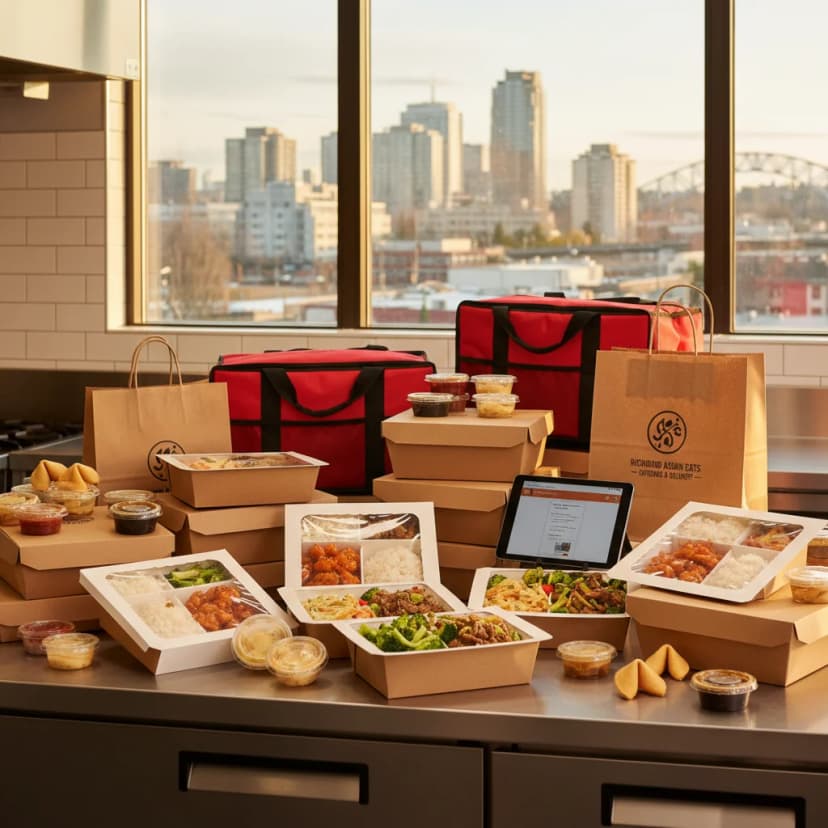
Richmond Asian Catering: Pickup and Delivery Options
Explore Richmond Asian catering with flexible pickup and delivery options from Flavory Food. Fresh a
Want to taste our meals?
Book a free tasting and let our fresh ingredients speak for themselves.
Free Tasting