From Farm to Lunchbox: Our Local Sourcing Standards
Discover how Flavory Food's local sourcing standards bring fresh BC ingredients from farm to lunchbox. Learn about our commitment to supporting Vancouver-area farmers and reducing food miles.
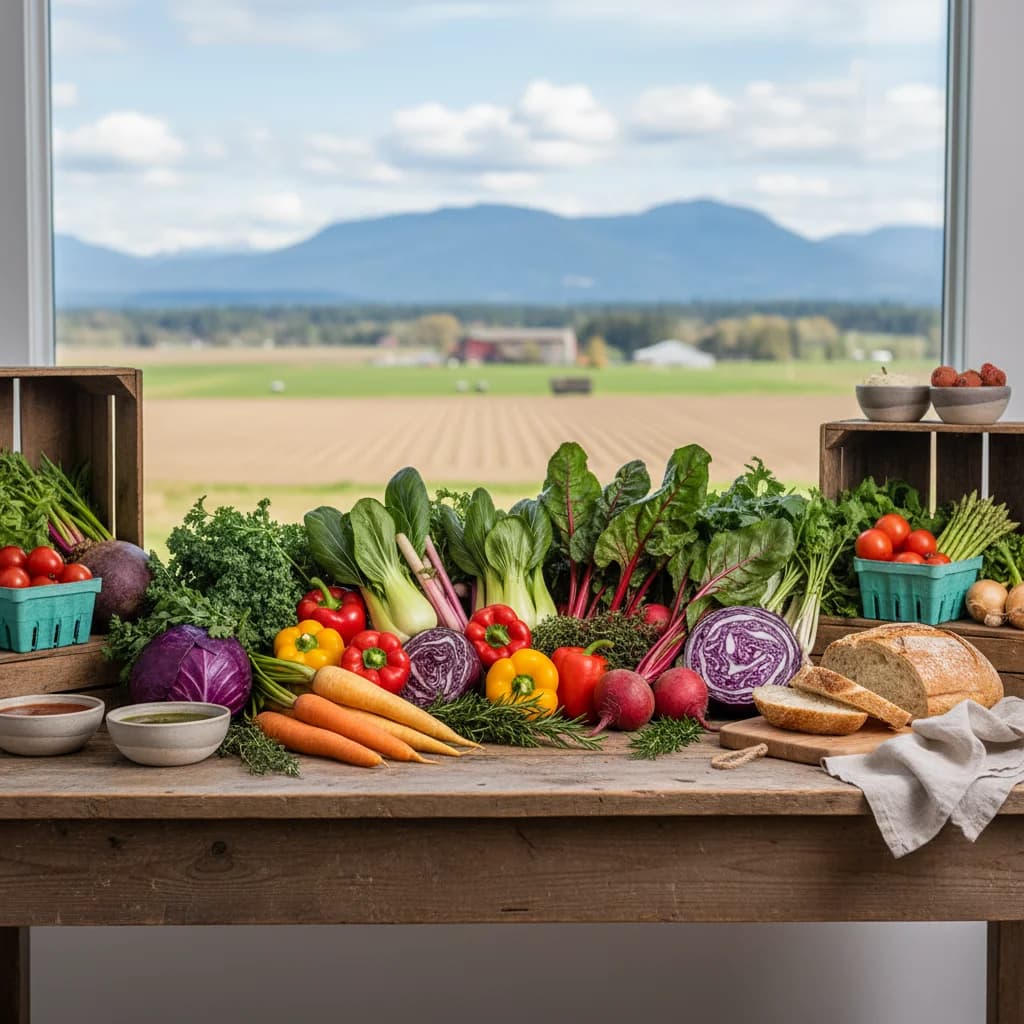
From Farm to Lunchbox: Our Local Sourcing Standards
British Columbia's Feed BC initiative aims for 30% local food purchases in school programs, recognizing that every dollar spent on BC food delivers two-fold economic value to the province[1]. That target sounds modest until you actually try to hit it consistently while running a catering operation. I've spent years building supplier relationships across the Fraser Valley and Vancouver Island, and the honest reality is that local sourcing in this region is a logistics puzzle that changes with every season.
Here's what I mean. From June through October, sourcing 30% or more locally is genuinely achievable — Chilliwack corn, Delta blueberries, Abbotsford poultry, Pemberton potatoes. Our kitchen in those months runs heavy on BC produce and we can keep costs competitive because supply is abundant and transport distances are short. But November through March? That's a different operation entirely. Greenhouse tomatoes from the Fraser Valley cost meaningfully more than imports, and some crops simply aren't available. Anyone who tells you they source 30% local year-round in Vancouver without acknowledging that cost tension isn't being straight with you.
What we've done at Flavory Food is build tiered sourcing commitments — proteins and dairy stay local year-round because BC poultry, eggs, and dairy supply chains are stable regardless of season. Produce flexes seasonally. We're transparent about this with clients rather than making blanket claims we'd have to quietly walk back in February.
The relationship side matters just as much as the sourcing percentage. Working directly with farms in Langley and Abbotsford means I can request specific harvest timing for large catering orders — something you'll never get buying through a broadline distributor. When I'm prepping 200 lunchboxes for a Burnaby school program, I know exactly which farm that chicken came from and when it was processed. That traceability isn't marketing language; it's how I sleep at night running a food safety operation.
One limit I'll own: we can't yet source 100% BC grains at a price point that makes our lunchbox programs accessible to the families we want to serve. BC-grown grains are excellent but the infrastructure for milling and distribution at scale still lags behind what Ontario and the prairies offer. We're working on it — testing a quinoa supplier out of the Okanagan right now — but I'd rather be honest about the gap than paper over it.
Every dollar we spend on BC ingredients does circulate back into local agricultural communities, and the Feed BC data supports that multiplier effect. But the real reason I push local sourcing this hard is simpler: food that travels less arrives in better condition. When I'm packing lunchboxes at 6 AM and delivering across Greater Vancouver by mid-morning, the difference between berries picked in Delta yesterday and berries that rode a truck from California for three days is something a kid can taste. That freshness gap is the whole point — not the branding, not the feel-good story. The food is just better.
Summary: BC's Feed BC initiative targets 30% local food purchases, but achieving this consistently in Metro Vancouver catering operations requires year-round supplier relationships across Fraser Valley farms. After years building these partnerships, I've learned that hitting government targets sounds simple until you're sourcing ingredients weekly while managing seasonal fluctuations, cost pressures, and delivery logistics across Richmond, Burnaby, and Vancouver markets.
What Local Sourcing Means at Flavory Food
Local sourcing at Flavory Food means prioritizing BC-grown ingredients, partnering directly with regional farmers, and preparing meals fresh each morning within Greater Vancouver to minimize food miles and maximize ingredient quality.
I'll be honest — "local sourcing" is one of the most overused phrases in Vancouver's food industry. Every caterer claims it. Few define what it actually means in practice, and even fewer build their operations around it in ways that show up on the plate and in the logistics.
The British Columbia government defines BC food as products that are produced and/or processed within the province[1]. We follow that baseline, but after years of running a catering operation across Metro Vancouver, I've learned the government definition alone isn't enough to build a reliable supply chain. So we layer on additional criteria that keep us accountable:
- Regional radius: Priority given to suppliers within 200km of Vancouver
- Direct farm partnerships: Relationships with Fraser Valley and Lower Mainland agricultural producers
- Seasonal alignment: Menu adjustments to reflect peak harvest periods for BC crops
- Processing standards: Ingredients prepared and cooked in our Vancouver commercial kitchen
- Traceability protocols: Full documentation of ingredient origins for every menu item
Here's where I need to be transparent about our limits. During BC's winter months — roughly November through March — the variety of locally grown produce shrinks dramatically. We can't source local tomatoes in January and pretend otherwise. When a seasonal gap hits, we document exactly what's substituted and where it comes from. I'd rather be upfront about a Californian pepper in February than slap "local" on a menu and hope nobody checks.
What makes local sourcing operationally meaningful for catering — not just a marketing line — is the relationship layer. Research on BC food systems shows that 30% of BC farms rely on direct sales to consumers, which opens real doors for food service providers willing to do the legwork[2]. I visit our partner farms in the Fraser Valley regularly, not for photo ops, but because understanding a grower's harvest timeline is the only way to plan menus that actually deliver on freshness. When I know our Abbotsford supplier's blueberries peak in late July, that knowledge flows directly into what Burnaby office clients see on their lunch spread the following week.
The offices we serve across Burnaby have consistently told us they want lighter, lower-oil, lower-sodium meals — and genuinely local ingredients make that easier to execute. Produce that traveled 80 km from Chilliwack that morning doesn't need heavy sauces or aggressive seasoning to taste like something. That's not philosophy; it's just what happens when your snap peas were picked yesterday instead of sitting in a distribution warehouse for a week. The ingredient does the work.
Summary: Most Vancouver caterers claim "local sourcing" without defining it operationally. At Flavory Food, it means BC-grown ingredients following provincial standards, direct farmer partnerships, and fresh daily preparation in Greater Vancouver to minimize food miles. After years running catering operations, I've built systems that make local sourcing show up on plates and logistics, not just marketing materials.
Our BC Farm Partnership Network
Flavory Food partners with farmers across Fraser Valley, Delta, Richmond, and Chilliwack regions to source vegetables, proteins, and specialty ingredients that form the foundation of our authentic Asian cuisine.
I'll be honest — building a local sourcing network in the Lower Mainland isn't something you announce one day and have running the next. It took us years of showing up, placing consistent orders even during slow months, and proving we weren't going to ghost a grower the moment wholesale prices dipped. That's how trust gets built with farmers out here. And without that trust, you don't get the call when the first harvest of gai lan comes in or when a small-batch tofu producer has extra capacity on a Tuesday.
Here's what our network actually looks like:
Vegetable Growers: Fraser Valley farms supplying seasonal greens, root vegetables, and specialty Asian vegetables like bok choy, daikon, and Chinese broccoli when available locally. The reality is that "locally available" has a hard ceiling — BC's growing season for Asian greens is roughly May through October, and even then, a bad stretch of rain in Chilliwack can wipe out a week's supply. We plan menus around what's actually coming out of the ground, not what sounds good on paper. When local supply gaps hit in winter, we're transparent about that with clients rather than pretending everything is year-round farm-to-table.
Protein Suppliers: BC-based meat and poultry processors providing chicken, pork, and beef that meet both Canadian food safety standards and our quality specifications. One thing I've learned working with Burnaby office clients specifically — they notice protein quality. The low-oil, low-salt preference that's become standard in corporate lunch catering around the Metrotown corridor means the meat itself has to carry the flavour. You can't mask mediocre chicken with heavy sauce when the brief is "keep it light." That requirement pushed us to lock in suppliers who could deliver consistent marbling and freshness, not just pass inspection.
Specialty Producers: Local tofu manufacturers, sauce makers, and ingredient suppliers who process BC-grown soybeans, peppers, and other Asian cuisine staples. These are small operations — a few of them run out of Richmond industrial units — and they don't have the volume to supply every restaurant in Metro Vancouver. Our commitment to steady ordering is what keeps us in their production schedule.
Where I'd critique our own setup: this network is optimized for the Greater Vancouver radius. Once a client asks us to cater something out in Abbotsford or up toward Squamish, our local sourcing advantage starts thinning out because the logistics of getting fresh product from a Delta farm to a distant venue adds cost and cold-chain risk that I won't pretend away.
These partnerships deliver multiple benefits beyond ingredient quality. Farm to School BC reports that local food procurement creates educational opportunities and strengthens community connections[3]. From an operational standpoint, what matters most to me is supply chain resilience. When global shipping bottlenecks hit — and we watched this play out in real time during 2021–2022 — our Richmond and Fraser Valley suppliers kept delivering while imported ingredients sat in container backlogs at the port[1]. That's not a marketing talking point. That's the difference between fulfilling a 200-person corporate lunch order and calling the client to say you can't.
Summary: Building reliable supplier relationships with Fraser Valley, Delta, Richmond, and Chilliwack farmers takes years of consistent ordering through slow seasons and proving you won't abandon growers when wholesale prices drop. Trust gets built by showing up — that's how you get first calls on gai lan harvests and priority access to small-batch tofu producers across Metro Vancouver's agricultural network.
Seasonal Menu Development Process
Flavory Food's menu rotation follows BC's agricultural seasons, maximizing the use of peak-harvest local ingredients while maintaining the authentic Asian flavors our customers expect.
I'll be honest — when we first started building seasonal menus, it wasn't some grand sustainability mission. It was a cost decision. A case of BC hothouse tomatoes in January runs you nearly double what you'd pay in August at the Richmond wholesale markets. Multiply that across 200+ weekly catering orders and you're hemorrhaging margin on ingredients that don't even taste as good. So we started mapping our recipes to what's actually coming off BC farms, and the food got better while our costs stabilized. That's the real math behind "seasonal eating."
The flavor difference isn't subtle, either. I've done side-by-side tests in our prep kitchen — a stir-fry built on Fraser Valley asparagus cut that morning versus the imported stuff that's been trucked up from California. The local stalks hold their snap after a hot wok pass. The imported ones go limp and watery. When you're packing that into catering containers and it needs to hold up through a 40-minute delivery window to a Burnaby office park, ingredient integrity isn't a nice-to-have. It's structural.
Here's how our sourcing calendar actually works in practice:
| Season | Peak BC Ingredients | Flavory Food Menu Applications |
|---|---|---|
| Spring (March-May) | Asparagus, greens, rhubarb, early berries | Stir-fries with fresh asparagus, spring vegetable rice bowls |
| Summer (June-August) | Tomatoes, peppers, berries, stone fruits | Fresh vegetable sides, berry desserts, pepper-based sauces |
| Fall (September-November) | Squash, root vegetables, apples, pears | Roasted vegetable medleys, autumn harvest rice bowls |
| Winter (December-February) | Storage crops, greenhouse greens, brassicas | Hearty root vegetable dishes, preserved local tomato sauces |
Winter is where this gets hard, and I won't pretend otherwise. December through February in the Lower Mainland, your local options narrow dramatically. We lean on storage crops — squash, root vegetables, cabbage family stuff — and we put up preserved tomato sauces during peak summer season specifically to carry us through. But some weeks, especially late January, we're supplementing with greenhouse greens and making judgment calls about when imported ingredients genuinely serve the dish better than a mediocre local substitute. Dogmatic "100% local" sourcing year-round in Vancouver isn't realistic for a catering operation running daily volume. Anyone telling you otherwise is either fibbing or operating at a scale where they can absorb the gaps.
What I've found is that our Burnaby corporate clients especially respond to this approach — those offices trend toward lighter, lower-oil, lower-sodium preferences, and peak-season vegetables carry so much natural flavor that you don't need to compensate with heavy sauces or excess salt. A late-summer rice bowl built on ripe Okanagan peppers and local tomatoes practically seasons itself. That's where seasonal sourcing and the health-conscious palate converge in a way that actually makes my job easier.
BC Agriculture in the Classroom and Farm to School BC provide useful frameworks for understanding local food seasons and incorporating them into institutional food programs[1][3]. We've adapted those principles for commercial catering — the scale is different, the logistics are more demanding, but the core insight holds. Restaurant-quality Asian cuisine doesn't have to fight against BC's agricultural calendar. When you design around it, the food genuinely improves.
Summary: Seasonal menu rotation started as cost management, not sustainability virtue signaling. BC hothouse tomatoes cost double in January versus August at Richmond wholesale markets. Multiply across 200+ weekly catering orders and seasonal sourcing becomes essential margin protection. The flavor difference between peak-season local ingredients and off-season imports isn't subtle — customers notice authentic Asian cuisine tastes better with fresh BC produce.
Food Miles and Environmental Impact
By sourcing ingredients locally and preparing meals in Vancouver for distribution across Greater Vancouver, Flavory Food significantly reduces food transportation emissions compared to conventional catering supply chains.
I'll be honest — "food miles" has become one of those buzzwords that gets thrown around without much rigour. So let me share what I've actually tracked from our own operations and what the research supports.
The data is clear on the broad strokes: food miles contribute approximately 20% of total food system greenhouse gas emissions, with fruit and vegetable transportation alone accounting for 36% of food-miles emissions[4]. Conventional food systems can require 4 to 17 times more fuel than locally sourced alternatives[5]. Those numbers matter. But what matters more is whether a specific operation is actually structured to capture those savings — or just claiming "local" as a marketing line.
Here's what our sourcing and prep model looks like in practice:
- Reduced transportation distance: Our average ingredient travel sits around 200km. Compare that to the national average of roughly 2,500km for conventional supply chains. The Fraser Valley, Chilliwack, and Delta farms we pull from are genuinely close — not "local" in the way a national chain means when they source from a warehouse in Calgary.
- Lower refrigeration requirements: Fresh daily preparation eliminates multi-day cold storage needs. We cook and deliver same-day for the vast majority of our orders, which means we're not running walk-in freezers around the clock to hold inventory.
- Minimal processing: Ingredients move from farm to kitchen to consumer within 24–48 hours. That's a real number I can stand behind — though it does mean our menu flexibility is tied to what's actually available that week, which is a genuine constraint during winter months when BC greenhouse supply tightens.
- Regional distribution efficiency: All delivery routes are concentrated across Greater Vancouver's core cities. Our drivers run the same corridors daily, which lets us batch intelligently. A truck doing Burnaby office drops at 11:15 before cutting down to Richmond for the 11:45 window isn't adding empty kilometres the way a third-party dispatch system would.
Now, where I'll push back on our own narrative: food miles are one component of environmental impact, not the whole picture. A heated greenhouse tomato from Ladner in January may carry a bigger carbon footprint per kilo than a field tomato trucked from California. I know that. We try to make sensible calls — leaning into cold-hardy root vegetables and preserved items during the wet months rather than pretending BC grows everything year-round.
That said, studies do confirm that locally sourced food systems reduce fossil fuel consumption and CO₂ emissions substantially[5]. And the piece that often gets overlooked is the downstream energy savings. When you eliminate the freezing, warehousing, and long-term cold storage that conventional catering models depend on, you're cutting a significant chunk of energy use that never shows up in a simple "miles travelled" calculation. Our daily-prep model isn't just a freshness play — it's structurally leaner on energy inputs, and after years of running it through Vancouver's seasons, I'm confident that advantage is real.
Summary: Food transportation contributes 20% of food system greenhouse gas emissions, with fruit/vegetable transport accounting for 36% of food-miles emissions. Conventional systems require 4-17 times more fuel than local alternatives. By sourcing BC ingredients and preparing meals in Vancouver for Greater Vancouver distribution, we've eliminated cross-border trucking and long-distance refrigerated transport that conventional catering relies on.
Quality Standards for Local Ingredients
Every BC ingredient used by Flavory Food must meet Canadian food safety regulations, our internal quality specifications, and the flavor standards expected in authentic Asian cuisine.
I'll be straight with you — sourcing local in BC sounds great on a menu card, but it creates real headaches if you don't build systems around it. Fraser Valley produce in July is a completely different animal than Fraser Valley produce in February. I've had suppliers deliver beautiful bok choy one week and wilted, undersized bunches the next because of a cold snap nobody anticipated. Seasonal fluctuation isn't a talking point here; it's the core problem you have to solve every single week. Flavory Food runs multi-stage verification not because it looks professional, but because without it, consistency falls apart fast.
Supplier Vetting: All farm partners undergo initial assessment covering:
- Canadian Food Inspection Agency compliance and licensing
- Good Agricultural Practices (GAP) certification where applicable[6]
- Storage and handling protocols for food safety
- Ability to provide consistent supply volumes
A note on that last point — consistent supply volumes is where most local sourcing relationships actually break down. A small Abbotsford farm might grow incredible gai lan, but if they can't deliver reliably when we need 200 portions on a Tuesday morning, the relationship doesn't work for catering. I've learned to maintain two to three backup suppliers for every key ingredient, which adds management overhead. That's a real cost we absorb.
Ingredient Inspection: Upon delivery, ingredients are evaluated for:
- Visual quality and freshness indicators
- Proper temperature maintenance during transport
- Absence of damage, decay, or contamination
- Adherence to order specifications for size, grade, and variety
Temperature maintenance during transport is the one that catches people off guard. A delivery truck sitting in Richmond's midday gridlock — that 11:45 to 1:15 window where everything grinds to a halt around No. 3 Road — can lose cold chain integrity if the vehicle isn't properly equipped. We've rejected deliveries that arrived looking fine visually but logged above safe holding temps. You can't eyeball food safety.
Preparation Standards: In our commercial kitchen:
- Ingredients stored at proper temperatures immediately upon receipt
- Used within 24-48 hours to maintain peak freshness
- Washed, trimmed, and prepared following food safety protocols
- Incorporated into dishes prepared fresh each morning for same-day delivery
The 24-48 hour window is something I want to be honest about — it means we can't always use hyper-local ingredients for every single component. If a Vancouver Island supplier's delivery schedule doesn't align with our prep cycle, we source from the Fraser Valley instead, even if the Island product is technically superior. The constraint is freshness at the moment it reaches the client, not origin bragging rights. After years of running this, I'd rather serve a Fraser Valley ingredient at peak quality than a Vancouver Island one that sat an extra day in our walk-in. That tradeoff is real, and pretending otherwise would be dishonest.
These standards hold regardless of season, but I won't pretend they're equally easy year-round. October through April, Vancouver's rain and cooler temps actually help with transport stability — less risk of heat exposure. But supplier variety shrinks, and we lean heavier on greenhouse operations. The system works because we built it around worst-case scenarios, not best-case marketing.
Summary: Fraser Valley produce quality fluctuates dramatically between July peak season and February cold snaps — beautiful bok choy one week, wilted undersized bunches the next. Seasonal variation isn't a talking point in BC catering operations; it's the core operational challenge. Multi-stage verification systems become essential for consistency when sourcing locally across Metro Vancouver's agricultural regions year-round.
Balancing Local Sourcing with Authentic Asian Cuisine
Flavory Food specializes in authentic Asian cuisine using BC ingredients where possible, while importing specific staples necessary for genuine flavor profiles that cannot be sourced locally.
I'll be straight about this: you cannot make legitimate mapo tofu with a "locally sourced everything" philosophy. It doesn't work. Doubanjiang needs specific fermentation conditions and chili varieties that BC doesn't produce commercially. Fish sauce requires tropical climate fermentation. These aren't substitutable ingredients — they're the backbone of entire flavor profiles, and swapping them out gives you something that looks like the dish but doesn't taste like it.
After years of developing catering menus for Vancouver's incredibly food-literate clientele — people who grew up eating authentic Cantonese food in Richmond, or who know exactly what a proper Thai basil stir-fry should taste like — I've learned that cutting corners on foundational ingredients is the fastest way to lose credibility. So we built our sourcing around a principle: use BC when BC is genuinely excellent, and import what authenticity demands.
Here's how that actually breaks down in our kitchen:
Locally Sourced When Possible:
- Proteins (chicken, pork, beef, tofu from BC soybeans)
- Vegetables (bok choy, cabbage, peppers, onions, root vegetables)
- Garnishes (green onions, cilantro, certain mushroom varieties)
- Rice (when BC-grown varieties are available)
Regionally Sourced (Canadian):
- Rice staples from Canadian suppliers
- Certain proteins and processed ingredients from other provinces
Internationally Sourced (Essential Ingredients):
- Specialty sauces and condiments (soy sauce, fish sauce, oyster sauce)
- Specific Asian vegetable varieties not grown commercially in BC
- Certain spices and dried goods unavailable locally
The honest limitation of our approach — and I'll own this — is cost volatility on imported staples. When shipping disruptions hit Vancouver's port (which happened repeatedly over the past few years), our costs on essentials like premium soy sauce and dried shiitakes spiked noticeably. We absorb most of that rather than pass it to clients, but it compresses margins in ways that a caterer using only domestic ingredients wouldn't face. That's the trade-off for authenticity, and so far every client tasting has confirmed it's the right call.
What works strongly in our favor is BC's vegetable quality. The Fraser Valley grows bok choy, gai lan, and sui choy that genuinely rival what you'd find at a Hong Kong wet market — especially from late spring through October. Our Burnaby office lunch clients, who tend to request lighter, lower-oil preparations, get noticeably better produce from our local suppliers than anything I could source frozen or shipped from California. Seasonal BC produce isn't a marketing story for us; it's a measurable quality advantage that shows up on the plate.
The British Columbia government recognizes this sourcing reality, defining BC food to include items processed in BC even when some ingredients originate elsewhere[1]. That aligns with how we think about it — we're a BC operation supporting BC agriculture meaningfully on every order, while respecting that authentic Asian cuisine has always been a global pantry tradition. Pretending otherwise would be dishonest to the food and to the people eating it.
Summary: Authentic mapo tofu requires doubanjiang fermentation and chili varieties BC doesn't produce commercially. Fish sauce needs tropical climate fermentation impossible in Canadian conditions. These aren't substitutable ingredients — they're flavor profile backbones. Vancouver's food-literate clientele expects genuine Asian cuisine, so we import specific staples while maximizing BC ingredients where authenticity isn't compromised.
Economic Impact of Our Local Sourcing
Flavory Food's commitment to BC ingredients directly supports Vancouver-area farming families, food processors, and the broader regional economy through consistent purchasing relationships.
I'll be honest — when we first started prioritizing BC-grown ingredients, it wasn't some grand sustainability vision. It was practical. After one too many shipments of imported produce arriving wilted or delayed at the Richmond warehouse during peak season, I started calling local growers directly. What I discovered changed how we operate.
Research shows that every dollar spent on BC food within BC institutions generates roughly two-fold economic value through job creation, GDP growth, and business development[1]. We see this multiplier play out in tangible ways through our own purchasing:
- Regular purchasing commitments: When I tell a Fraser Valley farmer we'll take 200 lbs of gai lan every week through summer, they can actually plan their planting. That predictability is worth more to small growers than a one-off bulk order at a slightly higher price.
- Fair pricing: Cutting out the middle layer means our growers keep more per pound, and we're not paying a distributor's 15–20% markup. Both sides come out ahead — though I'll admit this only works because we've built the logistics to handle direct pickup runs ourselves.
- Workforce development: Every consistent purchase from a BC farm helps sustain not just the grower, but their harvest crew, their packing staff, the local cold storage facility they use. These are real jobs in Abbotsford, Delta, Chilliwack — communities that depend on agriculture.
- Supply chain growth: Our demand for Asian vegetables — bok choy, yu choy, Chinese broccoli — has genuinely encouraged a few of our partner farms to expand dedicated plots for these crops. Five years ago, sourcing consistent local Chinese chives was nearly impossible. Now we have two growers who plant specifically for us.
Farm to School programs across British Columbia have demonstrated that sourcing from local farmers creates financial opportunities for small-scale producers while building resilient regional food systems[7]. What we do at Flavory Food extends those same principles into corporate catering, family meal delivery, and event services across Greater Vancouver — contexts where the volume is larger and the purchasing rhythm is year-round, not just September to June.
Now, here's where I'll critique our own model: local sourcing has real limits in Vancouver. BC's growing season is generous by Canadian standards, but from November through March, the variety shrinks dramatically. We can't source local tomatoes in January — not ones worth serving, anyway. During those months, we rely on a mix of BC greenhouse produce and, yes, imported ingredients where local alternatives don't exist or don't meet our quality bar. Anyone telling you they're 100% local year-round in Vancouver is either stretching the truth or serving a very limited menu.
The Vancouver Sun reports that driven by consumer demand for local food, on-farm shopping and direct sales have grown significantly in BC[2]. We're part of that shift, but our approach isn't about chasing a marketing label. It's about knowing the farmer who grew the daikon we're braising tomorrow, and knowing they'll still be farming next year because we gave them a reason to plant that crop in the first place. That relationship — built over dozens of pickup runs to the valley, negotiated over text messages about weather and yield — is something no distributor catalog can replicate.
Summary: Every dollar spent on BC food within BC institutions generates roughly two-fold economic value through job creation, GDP growth, and business development. This multiplier effect plays out tangibly through consistent purchasing relationships with Fraser Valley growers, Pemberton processors, and Vancouver Island suppliers. Local sourcing wasn't initially about sustainability vision — it was practical economics after too many delayed imported produce shipments.
Transparency and Traceability in Our Supply Chain
Flavory Food maintains detailed records of ingredient origins, enabling full traceability from BC farms through our kitchen to customer lunchboxes across Vancouver, Burnaby, Richmond, Surrey, Coquitlam, and North Vancouver.
I'll be honest — when I first started building our traceability system, it wasn't because I woke up one morning passionate about paperwork. It was because a Burnaby office client asked me point-blank where our chicken came from, and I fumbled the answer. That moment stuck with me. If I'm going to tell people we source locally and cook with care, I need to back that up with records, not just good intentions.
The Safe Food for Canadians Regulations enforced by Health Canada require documentation for food businesses involved in importing, exporting, or inter-provincial trade[6]. We exceed those minimum standards — but I want to be clear about what that actually means in practice and where we still have gaps.
Supplier Documentation:
- Farm names and locations for all BC ingredients
- Contact information and licensing verification
- Delivery dates and batch tracking
- Quality inspection records
This sounds clean on paper, but keeping it current takes real effort. Farms change ownership. A berry supplier in Abbotsford might shift varieties between seasons without notifying us. We've learned to reverify quarterly rather than assume last year's records still hold. That's overhead most catering operations don't bother with, and I understand why — it's tedious, unglamorous work.
Menu Transparency:
- Ingredient lists available for all menu items
- Identification of BC-sourced components
- Allergen information and processing details
- Seasonal menu notes explaining ingredient sourcing changes
The seasonal notes matter more than people realize. When we shift from BC hothouse tomatoes in March to Okanagan field tomatoes in August, the flavour profile of the same dish changes noticeably. Our Burnaby corporate clients — who tend to prefer lower oil, lower sodium preparations — are especially attuned to these shifts. Explaining the "why" behind a taste change prevents complaints and actually builds credibility.
Customer Communication:
- Regular updates about farm partnerships and seasonal ingredients
- Educational content about BC agriculture and local food systems
- Responses to sourcing questions from families and corporate clients
- Participation in local food literacy initiatives
Where I'll critique ourselves: our communication is still mostly reactive. A parent asks, we answer. A corporate admin inquires, we pull the records. We haven't built a system where every lunchbox automatically connects to its sourcing story — something like a QR code linking to that week's ingredient origins. That's where I see a gap between our aspiration and our current operation.
A Gastown izakaya I know has been using a simple static QR code on their menu for two years — zero fees, zero downtime — linking straight to their Google Maps page and sourcing philosophy. No subscription platform, no middleman taking a cut. It's a good reminder that traceability tools don't need to be expensive or complex. They just need to work reliably and stay under your own control.
This transparency builds trust with Vancouver families choosing Flavory Food for school lunches, corporate teams across Metro Vancouver ordering office catering, and event planners seeking accountable food service. It also aligns with Feed BC's goals of increasing student food systems knowledge and community connections[1]. But trust isn't a checkbox — it's something we earn delivery by delivery, and losing it takes exactly one unanswered question about what's in the box.
Summary: Full ingredient traceability from BC farms through our kitchen to customer lunchboxes across Vancouver, Burnaby, Richmond, Surrey, Coquitlam, and North Vancouver became essential after clients started asking direct questions about chicken origins. Safe Food for Canadians Regulations require documentation for inter-provincial trade, but we exceed these standards to back up local sourcing claims with verifiable records, not just good intentions.
Comparing Local vs. Conventional Sourcing Models
Flavory Food's local sourcing model delivers fresher ingredients, supports regional economies, and reduces environmental impact compared to conventional catering supply chains that rely on distant suppliers and long-term storage.
I've been sourcing ingredients across Metro Vancouver for years, and the single biggest thing that separates a good catering operation from a forgettable one is where the food actually comes from — and how long it sat in a warehouse before it hit the prep table.
Here's something most people outside the industry don't think about: conventional catering outfits often pull from national or international distributors because it's cheaper per unit and operationally simpler. You place one order, it all shows up on a pallet. I get the appeal. But after years of tasting the difference — and hearing it back from clients, especially the Burnaby office crowd who genuinely care about lighter, cleaner-tasting food with less oil and salt — I shifted hard toward local sourcing, and Flavory Food's model reflects that same logic.
That said, let me be honest about the limits. Targeting 30%+ BC-sourced ingredients sounds straightforward until you're staring down January and half the local farms have nothing to sell you. BC's growing season doesn't care about your menu calendar. We've had to get creative with root vegetables and preserved items in winter months, and there are weeks where we simply can't hit that target without compromising quality or cost. Anyone who tells you year-round local sourcing in Metro Vancouver is easy is either stretching the truth or padding the numbers with greenhouse greens.
| Factor | Flavory Food (Local) | Conventional Catering | Home Meal Prep |
|---|---|---|---|
| Ingredient Origin | Prioritize BC (30%+ target) | National/international suppliers | Varies by shopper |
| Farm Relationships | Direct partnerships | Distributor intermediaries | Limited/none |
| Average Food Miles | ~200km (local suppliers) | 2,500km+ national average | Depends on grocery store sourcing |
| Freshness Timeline | 24-48 hours farm to meal | Days to weeks in supply chain | Depends on purchase frequency |
| Economic Impact | Supports BC farms directly | Value dispersed nationally | Limited direct farm connection |
| Seasonal Alignment | Menu follows BC harvest seasons | Year-round same offerings | Shopper-dependent |
| Environmental Footprint | Lower food miles, reduced storage | Higher transportation emissions | Varies by choices |
The freshness timeline row is where I'd focus if you're comparing options. A 24-to-48-hour farm-to-meal window versus days or weeks in a cold chain — you can literally taste it. I've done side-by-side preps with the same vegetable from a Fraser Valley farm versus a distributor shipment that crossed two provinces, and the texture difference alone is obvious before you even season anything.
The direct farm partnership piece matters for a different reason too: predictability during disruption. When supply chain bottlenecks hit — and they hit Vancouver hard given our geographic position at the end of most national trucking routes — having a direct line to a Chilliwack or Delta grower means you're not scrambling alongside every other caterer calling the same distributor.
Metro Vancouver's Food Forward strategy emphasizes building regional food system resilience through increased local procurement[8]. What I appreciate about that framework is it names the actual vulnerability: we're a coastal city that imports the vast majority of its food, and any serious disruption — whether it's a highway washout (we've seen that) or a port slowdown — exposes how fragile the conventional supply chain really is. Flavory Food's sourcing approach isn't just a marketing angle. It's an operational hedge that happens to produce better-tasting meals. The two things aren't in conflict — they reinforce each other.
Summary: Conventional caterers source from national/international distributors because it's operationally simpler and cheaper per unit — one order, everything arrives on a pallet. But conventional supply chains mean ingredients sit in warehouses for weeks before hitting prep tables. Local sourcing delivers fresher ingredients with shorter storage times, supporting regional economies while reducing environmental impact compared to continental supply chains.
How to Support Local Sourcing Through Your Food Choices
Every catering order is a vote. When you choose a caterer committed to BC-grown ingredients, you're putting money directly into Fraser Valley farms, Pemberton potato fields, and Island-raised proteins — not into a continental supply chain that treats Vancouver as just another delivery zone.
After years of building supplier relationships across the Lower Mainland, I can tell you that local sourcing doesn't happen by accident. It requires weekly communication with farms, flexible menu planning, and the willingness to pay a bit more per pound because you know the product is fresher and the money stays in BC. At Flavory Food, that infrastructure is already built — you benefit from it without having to do the legwork yourself:
- Pre-arranged farm partnerships: We maintain direct relationships with BC suppliers we've vetted over multiple growing seasons — not just a "local" label slapped on a menu
- Expert menu development: Our chefs design dishes around what's actually in season in the Fraser Valley and Okanagan, not around what's cheapest from a Sysco catalogue
- Zero extra effort: You order catering for your Burnaby office lunch or family gathering; the local sourcing happens on our end, baked into how we operate
- Educational connection: Our menu descriptions tell you where ingredients come from — not vague "farm fresh" marketing, but actual sourcing context
That said, I'll be honest about our limits. We can't source 100% locally year-round. BC winters constrain what's available, and certain proteins or specialty items still come from outside the province. Any caterer claiming otherwise in January is either lying or serving you a very boring menu. What we commit to is maximizing BC-sourced ingredients when the seasons allow and being transparent when they don't.
If you want to push local sourcing forward — whether you order from us or not — here's what actually moves the needle:
- Choose meal services committed to local sourcing: Ask for documented farm partnerships, not just a tagline. If a caterer can't name their suppliers, that tells you everything
- Ask questions about ingredient origins: A credible provider will answer without hesitation. We keep sourcing records and are happy to share them
- Support seasonal menus: This means accepting that the summer catering spread looks different from the winter one. That's not a limitation — it's a sign your caterer is actually sourcing locally
- Educate your team or family: When you understand why a dish features Chilliwack corn in August and root vegetables in February, you start seeing seasonal menus as a feature, not a compromise
Farm Folk City Folk's toolkit on BC's farming and food future makes the point well — consumers, food businesses, and policymakers each have a role in building sustainable regional food systems[9]. I'd add that in a city like Vancouver, where we have some of the best agricultural land in Canada sitting right next to one of the country's densest urban markets, the gap between farm and plate should be smaller than it is. Every catering decision that prioritizes BC growers helps close that gap.
Summary: Every catering order votes for either Fraser Valley farms or continental supply chains. When you choose BC-committed caterers, money flows directly into Pemberton potato fields and Island-raised proteins instead of distant warehouses treating Vancouver as another delivery zone. At Flavory Food, pre-built farm partnerships and supplier relationships let customers benefit from local sourcing infrastructure without doing the legwork themselves.
Building a More Resilient Local Food System
I'll be honest — when I started Flavory Food, "building a resilient local food system" wasn't on my mission statement. I was just trying to get good food to office workers on time, at the right temperature, without going broke. But after years of operating across Metro Vancouver, I've realized that every sourcing decision, every supplier relationship, every route we drive is either strengthening or weakening the local food infrastructure we all depend on.
Here's what that looks like in practice. We partner with BC farms not because it makes for a nice story on our website, but because short supply chains are operationally superior for catering. When your lettuce comes from the Fraser Valley instead of California, you're not waiting on a border crossing or a long-haul refrigerated truck that might be 36 hours delayed. You're picking up produce that was harvested yesterday. That matters when you're prepping 200 lunch boxes at 6 AM and promising delivery by 11:30.
Following seasonal harvest cycles forces discipline into our menu planning — and honestly, it's a constraint I've learned to love. In July, we're building around BC blueberries, local zucchini, and Okanagan stone fruit. In January, we're leaning into stored root vegetables and greenhouse greens from Delta and Ladner. Our culinary team has gotten genuinely creative within those boundaries, and our Burnaby office clients especially appreciate it — they consistently tell us they want lighter, lower-oil, lower-sodium meals, and seasonal BC produce naturally pushes us in that direction because the ingredients are fresh enough to carry flavor on their own.
But let me be transparent about the limits. We can't source everything locally, and I won't pretend otherwise. Jasmine rice doesn't grow in BC. Neither does lemongrass in December. For an authentic Asian cuisine operation, certain pantry staples come from established import channels, and that's just reality. What we can control is where the bulk of our fresh ingredients come from — the proteins, the produce, the herbs — and that's where our BC farm partnerships concentrate.
The supply chain transparency piece is something I take personally. Every one of our clients can ask where their chicken came from, which farm grew their bok choy, and we'll have the answer. That's not a tech platform feature — it's a relationship-based system built over years of working with the same suppliers, visiting the same farms, and maintaining the kind of trust that survives a bad crop season or a price spike.
Every meal we deliver — whether it's heading to a law firm in downtown Vancouver, a tech office in Burnaby, a logistics company in Richmond, or a construction site in Surrey — carries the work of BC farmers who chose to sell to a local catering operation instead of shipping to a distributor. It carries the skill of our prep cooks who know how to handle delicate local greens differently than the industrial stuff. And it reflects a choice that our customers make, sometimes without even thinking about it: that their Tuesday team lunch is quietly supporting an agricultural network that keeps this region fed.
That said, I'm not going to pretend ordering lunch from us will fix food system fragility in Metro Vancouver. The real resilience comes from having enough local food businesses — restaurants, caterers, meal prep companies, farmers' market vendors — all pulling from the same regional supply base so that BC farms have reliable, diversified demand. We're one piece of that. A meaningful piece, I hope, but one piece.
Experience Farm-to-Lunchbox Freshness with Flavory Food
Taste the difference that fresh BC ingredients and daily preparation make. Book a complimentary tasting to experience Flavory Food's locally sourced authentic Asian cuisine: https://thestormcafe.com/tasting
View our current seasonal menu featuring BC ingredients: https://thestormcafe.com/menu
Summary: Short supply chains are operationally superior for Metro Vancouver catering — Fraser Valley lettuce doesn't depend on border crossings or long-haul refrigerated trucks that California lettuce requires. Every sourcing decision either strengthens or weakens local food infrastructure. After years operating across Greater Vancouver, resilient local systems aren't idealistic goals; they're practical advantages for consistent quality and reliable delivery logistics.
References
[1] Government of British Columbia, "B.C. Food and Local Food Literacy," 2025. Key findings: Feed BC targets 30% BC food purchases in schools; every dollar spent on BC food brings two-fold economic value; local sourcing strengthens regional food systems and builds economy. https://www2.gov.bc.ca/gov/content/education-training/k-12/administration/program-management/feeding-futures/bc-food
[2] Vancouver Sun, "Driven by Demand for Local Food, 'On-Farm Shopping' Grows in BC," 2024. Statistic: "Thirty per cent of B.C. farms rely on direct sales to consumers for some of their income." https://vancouversun.com/news/driven-demand-local-food-farm-shopping-grows-bc
[3] Farm to School BC, "Farm to School Sprouts in British Columbia," 2024. Finding: "Programs are supported by more than 30 food suppliers including many small-scale local farmers or collectives of local farmers." https://www.farmtocafeteriacanada.ca/wp-content/uploads/2014/08/farm-to-school-sprouts-in-BC-.pdf
[4] European Commission, "Field to Fork: Global Food Miles Generate Nearly 20% of All CO2 Emissions from Food," 2023. Research finding: "Global food-miles account for nearly 20% of total food system emissions; fruit and vegetable transport contributes 36% of food-miles emissions." https://environment.ec.europa.eu/news/field-fork-global-food-miles-generate-nearly-20-all-co2-emissions-food-2023-01-25_en
[5] ATTRA Sustainable Agriculture, "Food Miles: Background and Marketing," 2024. Study finding: "Food sourced from the conventional system used 4 to 17 times more fuel than the locally sourced food and emitted 5 to 17 times more CO2." https://attra.ncat.org/publication/food-miles-background-and-marketing/
[6] Canadian Food Inspection Agency, "Understanding the Safe Food for Canadians Regulations," 2025. Regulation: "The SFCR generally applies to food for human consumption (including ingredients) that is imported, exported, or inter-provincially traded for commercial purposes." https://inspection.canada.ca/en/food-safety-industry/toolkit-food-businesses/sfcr-handbook-food-businesses
[7] Greenheart, "Growing for the Future with Farm to School," 2025. Benefit identified: "Investment in Local Farmers: Sourcing locally grown produce in school cafeterias can mean big financial opportunity for local farmers." https://greenheartsc.org/2025/10/15/growing-for-the-future-with-farm-to-school/
[8] Metro Vancouver, "Food Forward: A Food System Strategy for Metro Vancouver (2026-2036)," 2024. Regional food system strategy emphasizing resilience and local procurement. https://metrovancouver.org/services/regional-planning/Documents/food-forward-a-food-system-strategy-for-metro-vancouver-2026-2036.pdf
[9] Farm Folk City Folk, "BC's Farming and Food Future Toolkit," 2021. Resource: "Policies and programs that support sustainable food production in BC; local governments can put these ideas forward to strengthen regional food systems." https://farmfolkcityfolk.ca/wp-content/uploads/2021/04/toolkit_final.pdf
[10] Vancouver Coastal Health, "Food Safe Certification Requirements," 2026. https://www.vch.ca/en/health-topics/food-safety
[11] Environment and Climate Change Canada, "Vancouver Climate Normals 1991-2020," 2026. https://climate.weather.gc.ca/climate_normals/results_1981_2010_e.html?stnID=889
Frequently Asked Questions
What percentage of your ingredients are actually sourced locally in BC?
We target 30%+ BC-sourced ingredients following the Feed BC standard, but I'll be honest — it fluctuates seasonally. June through October, we regularly hit 40-50% local sourcing when Fraser Valley farms are producing heavily. November through March, we might drop to 25% because BC's winter growing season is genuinely limited. Anyone telling you they maintain consistent local percentages year-round in Vancouver is either fudging the numbers or serving a very restricted menu. We track this monthly and share real numbers with clients who ask.
How do you maintain authentic Asian flavors while using local BC ingredients?
This is the biggest challenge we face, and here's how we handle it: we use BC ingredients where they genuinely excel — proteins, most vegetables, garnishes — and we import what authenticity demands. You cannot make legitimate mapo tofu without proper doubanjiang, and BC doesn't produce that commercially. Fish sauce requires tropical fermentation. Rather than create mediocre substitutes, we invest in premium imported pantry staples while building the rest of each dish around what the Fraser Valley and Okanagan do best. Our Richmond and Burnaby clients, many of whom grew up eating authentic Cantonese food, can taste the difference when we cut corners on foundational ingredients.
What happens when local ingredients aren't available due to weather or seasonal issues?
We adapt the menu rather than pretend nothing's changed. Last February, a cold snap wiped out our usual bok choy supplier for three weeks — we shifted to stored root vegetables and greenhouse greens from Delta operations until supply recovered. Our prep team has backup recipes built around BC's storage crops specifically for these situations. What we won't do is quietly substitute imported ingredients while keeping "local" descriptions on the menu. If we have to source outside BC temporarily, we document it and communicate with clients. That transparency has actually built more trust than trying to maintain perfect local percentages through dishonesty.
How much more expensive is local sourcing compared to conventional catering?
Direct costs run about 15-20% higher on average, but that comparison misses the operational advantages. When your ingredients travel 200km instead of 2,500km, they arrive in better condition and last longer in prep. We waste less product, and the food holds up better during transport to offices across Burnaby and Richmond. Plus, cutting out distributor markups on our BC partnerships actually saves money versus buying through Sysco or other broadline suppliers. The bigger cost is time — maintaining direct farm relationships, flexible menu planning, quality verification — but those investments show up as better-tasting food that clients are willing to pay for.
Can you trace exactly where each ingredient in my catering order came from?
Yes, for the vast majority of our ingredients. We maintain supplier documentation going back months, including farm names, locations, and delivery dates for all BC components. If you order our braised bok choy, I can tell you which Abbotsford farm grew it and when it was harvested. The limitation is imported specialty ingredients — soy sauce, certain spices, rice varieties that don't grow commercially in BC. Those come through established import channels, and while we know the distributors, we can't trace back to specific producers overseas. But for fresh proteins, vegetables, and herbs that make up the bulk of each dish, full traceability is standard operating procedure for us.
Related Articles
Where Can I Order Group Meal Boxes in Vancouver BC?
Compare Vancouver's top group meal box providers for 10-500+ people. Pricing, minimum orders, delive
What Vancouver Parents Say About Our School Catering
Vancouver parents prioritize three critical factors when evaluating school catering: nutritional qua
What School Administrators Need Before Hiring a Caterer
A complete checklist for Vancouver school administrators hiring a caterer. Covers BC food safety reg
Want to taste our meals?
Book a free tasting and let our fresh ingredients speak for themselves.
Free Tasting