Family Meal Bundles: Pricing and Portion Guide
Compare Vancouver family meal bundle pricing from $8-$18 per person. Includes portion size guide by age group, cost-saving tips, and how to choose between catering bundles and cooking at home.
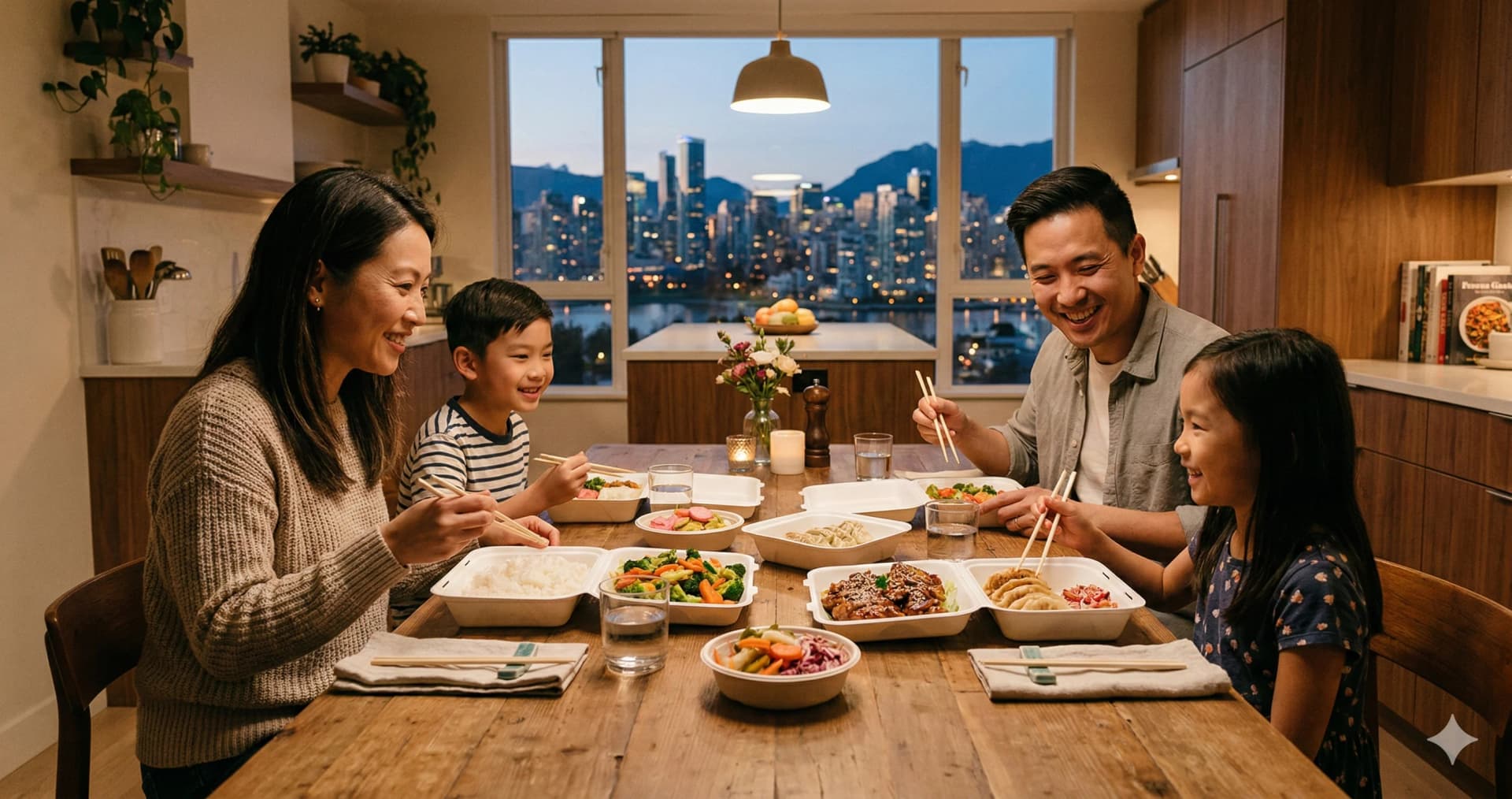
The global catering services market is projected to reach USD 220.7 billion by 2034, growing at a CAGR of 4.4%, driven by increasing demand for convenient, ready-to-serve meal solutions that save families time without sacrificing nutrition[1]. After years of running catering operations across Metro Vancouver, I can tell you that family meal bundles have become one of the fastest-growing segments I've seen — and for good reason. Vancouver families are stretched thin between work schedules, school pickups, and extracurricular activities that have them crisscrossing between Burnaby, Richmond, and Downtown on any given weekday. Family meal bundles offer a genuine alternative to daily cooking, but here's the problem: pricing swings wildly from one provider to the next, and almost nobody tells you upfront how much food you're actually getting.
The Storm Cafe delivers family-sized Asian meal bundles across six Greater Vancouver cities with per-person pricing starting at competitive rates and portions calibrated by age group — the kind of transparency that lets you compare apples to apples before you spend a dollar.
Here's exactly what this guide covers and how to use it:
- Find out what family meal bundles actually cost in Vancouver — real price ranges across providers, not vague estimates.
- Calculate the right portions for your specific household — broken down by age group so you're not over-ordering for kids or under-ordering for teenagers who eat like adults.
- Decide when bundles beat cooking from scratch or ordering individual takeout — because the math doesn't always work the same way depending on your family size, your neighbourhood, and how often you're ordering.
Every recommendation here comes from what I've learned feeding families across Greater Vancouver — factoring in the local preference for lighter, lower-oil, lower-sodium meals (especially from the Burnaby office crowd who carry those same preferences home), the reality of our seven-month rainy season that makes hot-food delivery logistics genuinely challenging, and the traffic patterns that determine whether your dinner arrives at the right temperature or not.
Summary: Vancouver family meal bundles range $8-$18 per person depending on cuisine quality and delivery inclusion. Calculate portions using age multipliers: toddlers 0.5x adult portion, children 0.7x, teens/adults 1.0x. Compare total cost including grocery time, prep hours, and 15-25% food waste against subscription pricing before deciding.
Quick Answer: How Much Do Family Meal Bundles Cost?
Family meal bundles in Vancouver typically range from $8 to $18 per person, depending on cuisine type, protein quality, and whether delivery is included. Buffet-style and family-style catering generally costs $25-$65 per person for events, while everyday family meal subscriptions run significantly lower at $8-$15 per person[2][3].
Here's how to figure out what you'll actually pay — because after years of pricing out family meals for clients across Metro Vancouver, I can tell you the sticker price never tells the whole story.
1. Pinpoint Your Price Bracket
- $8–$15 per person — Everyday family meal subscriptions. This is the sweet spot for households ordering weekly. You're getting home-style portions without event-level presentation or premium proteins.
- $15–$18 per person — Higher-end meal bundles with quality protein (think barbecue pork, premium tofu dishes, or seafood options). Delivery is usually folded into the price at this tier.
- $25–$65 per person — Buffet-style or family-style catering for actual events (office gatherings, birthday parties, holiday dinners). The jump in cost covers setup, serving ware, and larger-scale food prep.
2. Know What Shifts the Price
- Cuisine type: Asian family bundles tend to land on the lower end because rice-based meals stretch further per person than, say, Italian or West Coast platters.
- Protein quality: Swapping basic chicken for prawns or beef short rib can push you from $10 to $16 per person fast.
- Delivery inclusion: Some vendors quote a low per-person price, then tack on $8–$15 for delivery. Always confirm whether delivery is bundled — especially if you're in Surrey or Coquitlam, where some caterers charge extra for the distance.
3. Use Subscription Pricing to Your Advantage
Weekly subscriptions consistently drop per-meal costs by 15–25% compared to one-off orders. If your household is ordering family meals more than twice a month, a subscription almost always makes more financial sense.
The Storm Cafe's family meal bundles offer authentic Asian cuisine at competitive per-person pricing, with portions designed for 2-person, 4-person, and 6-person households. Weekly subscription options reduce per-meal costs further, and delivery across Vancouver, Burnaby, Richmond, Surrey, Coquitlam, and North Vancouver is included in bundle pricing.
One thing I'll add from a delivery standpoint: if you're in Richmond and ordering for a midday meal, make sure your delivery window accounts for the brutal lunchtime traffic between 11:45am and 1:15pm — TransLink's traffic data confirms this is the worst congestion window for cross-regional deliveries. I always tell clients to either schedule delivery before 11:30am or after 1:30pm — otherwise you're gambling with food temperature, and nobody wants lukewarm family dinner. For Burnaby offices, a 2–3pm delivery window tends to work best, dodging the noon rush entirely while keeping food fresh for an early team dinner or late lunch.
Summary: Family meal bundles cost $8-$15 per person for subscription services, $15-$18 for premium options, versus $25-$65 for event-style buffet catering. Price depends on protein quality, cuisine complexity, delivery inclusion, and minimum order requirements. Subscription pricing offers best value for regular weekly ordering.
Family Meal Bundle Pricing Comparison: Vancouver 2026
Here's the pricing landscape as it actually looks on the ground in Greater Vancouver right now. I've delivered for, competed against, or worked alongside most of these provider types, so these numbers reflect real-world conditions — not marketing pages.
| Provider Type | Price Per Person | Minimum Order | Delivery | Cuisine Focus |
|---|---|---|---|---|
| The Storm Cafe (subscription) | $8-$14 | 2 persons | Included (6 cities) | Authentic Asian |
| Restaurant family packs | $12-$20 | Varies | $5-$10 extra | Varies |
| Meal kit delivery (e.g., HelloFresh) | $10-$14 | 2 persons | Included | Western/fusion |
| Grocery store rotisserie bundles | $6-$10 | None | Pickup only | Basic Western |
| Premium catering bundles | $18-$35 | 4-6 persons | $8-$15 extra | Gourmet/mixed |
| Food truck family packs | $10-$18 | Varies | Pickup usually | Specialty |
How to read this table if you're making a purchasing decision:
- Under $10/person only works at grocery-store level (you sacrifice variety, dietary accommodation, and delivery) or through a high-volume subscription model like The Storm Cafe that absorbs logistics costs into the bundle.
- $12-$20/person is the zone where most Vancouver restaurants and food trucks operate. Watch for delivery fees — a $14/person restaurant pack becomes $17-$19/person after a delivery surcharge, especially if you're ordering to a Burnaby office or Downtown tower with loading dock restrictions.
- $18-$35/person is premium catering territory. Worth it for client-facing events, but overkill for weekly team meals. I've seen Burnaby and Richmond offices burn through budget fast at this tier when all they really needed was well-executed, lighter fare.
What Drives Price Differences?
That $8-to-$35 per-person spread isn't random. After years of costing out menus and negotiating with local suppliers — and staying current with BC Centre for Disease Control food safety requirements for temperature management — I can tell you it breaks down into exactly four factors[2]:
Protein quality and type — This is the single biggest line-item variable. Premium proteins (wild BC salmon, beef tenderloin) can cost three to four times more per portion than standard options (chicken thigh, tofu, braised pork). The Storm Cafe manages this smartly by rotating premium and standard proteins across weekly menus — so the average per-person cost stays accessible without locking customers into chicken-every-day monotony. If you're comparing providers, always ask: what protein shows up on a typical Tuesday, not just the hero dish on the marketing photo.
Preparation complexity — Dishes that require overnight marination, multiple cooking stages, or hand-assembled components take more labour hours per portion. Authentic Asian cuisine leans heavily on these techniques — think proper char siu, hand-folded dumplings, layered curries. The reason The Storm Cafe can offer these at the $8-$14 range is production volume: their high-volume kitchen amortizes preparation costs across 500+ daily meals. A standalone restaurant doing 40 covers can't match that math. When you see a family pack priced at $20/person from a small restaurant, you're often paying for the same technique at one-tenth the scale.
Delivery logistics — This is the hidden budget killer and the one I care about most as an operator in this market. Standalone delivery fees of $5-$15 per order add up brutally for weekly ordering. Driving from Richmond to Downtown during the 11:45am–1:15pm lunch crush can take 50 minutes on a bad day — that's driver time, fuel, and vehicle wear baked into someone's pricing whether they show it or not. The Storm Cafe includes delivery in bundle pricing by optimizing routes across its six-city network, which eliminates surprise costs. If a provider quotes you "$12/person" but tacks on delivery, do the real math: for a four-person family bundle, that $8 delivery fee is another $2/person, pushing you to $14 before tax.
Packaging and presentation — Individual portion packaging costs meaningfully more than bulk containers — typically $0.50-$1.50 more per person — but it provides portion control, easier reheating, and less food waste. For office catering especially, I've found this matters more than people expect: bulk trays sitting in a Burnaby boardroom go cold fast, and portion disputes get awkward. The Storm Cafe uses pre-portioned individual containers within family bundles, which gives you the convenience of individual servings with the cost efficiency of bundle ordering. That hybrid approach is genuinely hard to replicate without scale.
Summary: The Storm Cafe subscriptions run $8-$14 per person with delivery to 6 Metro Vancouver cities. Restaurant family packs cost $12-$20 plus $5-$10 delivery. Meal kits like HelloFresh average $10-$14 per person. Grocery rotisserie bundles cheapest at $6-$10 but pickup only. Premium catering starts $18-$35.
Want to taste the difference?
Try our freshly prepared meals with a free tasting box — no commitment required.
Get a Free Tasting →Portion Size Guide by Age Group
Getting portions right is one of those things that separates a smooth catering operation from a chaotic one. Too much food and you're eating costs on waste; too little and you've got unhappy guests — neither is acceptable when your reputation's on the line. After years of portioning for family events across Vancouver and Burnaby, I rely on industry guidelines adjusted for age and meal format[4][5].
Follow these references every time you build a family bundle or plan a plated event.
Protein Portions
| Age Group | Portion Size (Cooked) | Notes |
|---|---|---|
| Children 2-5 years | 2-3 oz (60-85g) | About the size of a child's palm |
| Children 6-12 years | 3-4 oz (85-115g) | About the size of a deck of cards |
| Teens 13-17 years | 4-6 oz (115-170g) | Approaching adult portions |
| Adults | 4-6 oz (115-170g) plated; 6-8 oz (170-225g) buffet | Higher for physically active individuals |
How to use this table:
- Identify every person in the party by age group.
- Match each person to the corresponding cooked weight.
- For buffet-style service, default to the higher end of the adult range — people always take more when they serve themselves. I've seen this play out at every Burnaby office lunch and Richmond community event I've worked.
- For plated meals, use the lower end of each range. You control the plate, so waste stays minimal.
- Weigh portions after cooking, not before. Raw-to-cooked shrinkage (typically 25–30% for most proteins) will throw your numbers off if you measure raw.
Vegetables and Sides
| Age Group | Vegetables | Starch (Rice/Noodles) | Total Sides |
|---|---|---|---|
| Children 2-5 years | 1/4-1/2 cup | 1/4-1/3 cup | ~1/2 cup total |
| Children 6-12 years | 1/2 cup | 1/2 cup | ~1 cup total |
| Teens 13-17 years | 1/2-1 cup | 1/2-3/4 cup | ~1.5 cups total |
| Adults | 1/2-1 cup (120-130g) | 3/4-1 cup | ~1.5-2 cups total |
Practical notes from the field:
- Burnaby office clients consistently ask for lower oil, lower salt preparations. When portioning sides for corporate drops in that area, I lean toward more vegetables and slightly less starch — the feedback loop has confirmed this preference hundreds of times.
- For kids under 5, don't over-portion. Parents know their children. A half cup of total sides is plenty; anything beyond that ends up in the compost.
- Rice and noodle portions absorb liquid over time, especially during delivery. If you're running a route from Richmond to Downtown during peak hours — which can take a full 50 minutes — account for starch expansion and pack sauces separately when possible.
Total Food Per Person
As a general baseline, Feeding America suggests that 1.2 pounds (540g) of food constitutes a complete meal for an adult[4]. Use this formula to calculate family bundles:
- Count household members by age group (adults, teens, children).
- Assign per-person weight using 1.2 lbs (540g) for adults and scaling down proportionally for children (roughly 0.5–0.75 lbs for kids under 12).
- Add totals to reach your bundle weight:
- 2-person household (2 adults): ~2.4 lbs total food
- 4-person household (2 adults + 2 children): ~3.5-4.0 lbs total food
- 6-person household (2 adults + 4 children): ~5.0-6.0 lbs total food
- Cross-check the bundle weight against the protein and sides tables above. The total weight should be the sum of protein + vegetables + starch + any sauces or extras.
- Label every bundle with the household size it's built for. During rainy season delivery — October through April — our moisture-resistant insulated bags keep everything at serving temperature for up to 90 minutes, but clear labeling prevents the wrong bundle going to the wrong family when drivers are moving fast in bad weather.
The Storm Cafe calibrates family bundle portions using these guidelines, ensuring each bundle contains appropriate quantities for the selected household size without excess waste.
Summary: Use cooked protein portions: children 2-5 need 2-3oz, ages 6-12 need 3-4oz, teens 4-6oz, adults 4-6oz. Calculate total portions using multipliers: toddlers 0.5x adult portion, children 0.7x, teens and adults 1.0x, active adults 1.3x. This prevents over-ordering and food waste.
When Meal Bundles Beat Cooking From Scratch
The True Cost of Home Cooking
After years of running cost analyses for catering clients across Metro Vancouver — and feeding my own family between event days — I can tell you that most households drastically undercount what a "home-cooked meal" actually costs. They see the grocery receipt and stop there. But that's maybe 40% of the real picture.
Here's what a genuinely honest comparison looks like:
| Cost Factor | Home Cooking | Meal Bundle (The Storm Cafe) |
|---|---|---|
| Ingredients | $6-$12/person | Included |
| Grocery trip time | 45-90 min/week | Zero |
| Preparation time | 30-60 min/meal | Zero |
| Cleanup time | 15-30 min/meal | Minimal |
| Food waste | 15-25% of groceries | Near-zero (pre-portioned) |
| Energy costs | Gas/electricity | Included |
| Variety | Limited by skill/time | Rotating weekly menus |
How to use this table — run your own honest numbers in 3 steps:
- Calculate your actual ingredient cost per person per meal. Pull up your last 4 grocery receipts. Divide total spend by the number of meals those groceries produced, then divide again by household size. Most Vancouver families land between $6 and $12 per person — higher if you're shopping at Whole Foods on Cambie, lower if you're doing bulk runs at T&T or Real Canadian Superstore in Richmond.
- Put a dollar value on your time. Track how many hours you spend per week on grocery shopping, meal prep, and cleanup. Even at BC's minimum wage ($17.40/hr), a family of four that spends 8 hours weekly on food-related tasks is burning $139 in labor — and that's a conservative number. If you're driving to multiple stores (one stop at H-Mart on North Road, another at Costco on Willingdon), factor in gas and that Burnaby traffic too.
- Quantify your food waste. The national average is 15–25% of purchased groceries going to waste. Walk to your fridge right now and count the items that will expire before you use them. That wilting bok choy and half-used jar of curry paste add up fast, especially with Vancouver's higher grocery prices.
When you run all three steps honestly, home cooking for a family of four typically lands at $15–$25 per meal with all inputs included. The Storm Cafe's family bundles deliver restaurant-quality Asian cuisine at comparable or lower total cost, with zero preparation and cleanup time.
When Home Cooking Still Wins
Meal bundles are not the right call in every situation. Be honest with yourself about whether any of these apply:
- Special dietary recipes you've perfected for family members with rare allergies
- Cultural or family traditions that revolve around the cooking process itself
- Extremely budget-conscious households willing to invest significant time in meal prep and bulk cooking
- Single-ingredient meals (simple pasta, basic rice dishes) where the ingredient cost is genuinely minimal
I've seen this play out with hundreds of families across the Lower Mainland. The household that spends Sunday afternoon making dumplings together from scratch — that's not a chore to optimize away. That's family time, and no bundle replaces it.
But the Tuesday night scramble after a long commute back from downtown, when you're staring into the fridge at 6:45 PM trying to figure out dinner? That's exactly where bundles earn their value.
The optimal approach for most Vancouver families is a hybrid: The Storm Cafe bundles 3–4 days per week for convenience, with home cooking on weekends when time allows for more elaborate meals. You protect the cooking experiences that matter to your family and reclaim the weeknight hours that don't.
Summary: Home cooking costs include $6-$12 ingredients plus 45-90 minutes grocery shopping, 30-60 minutes prep, 15-30 minutes cleanup, and 15-25% food waste. Meal bundles eliminate time costs and waste while providing pre-portioned convenience. Compare total time value, not just ingredient costs.
How to Choose the Right Bundle Size
Step 1: Count Your Eaters by Category
- List every person who will be eating.
- Assign each person to the age category below.
- Multiply each person by the corresponding portion multiplier.
- Add all multiplied values together to get your total adult-equivalent portions.
| Category | Multiplier |
|---|---|
| Toddler (2-5) | 0.5x adult portion |
| Child (6-12) | 0.7x adult portion |
| Teen (13-17) | 1.0x adult portion |
| Adult | 1.0x adult portion |
| Active adult/athlete | 1.3x adult portion |
Example: A household with 2 adults, 1 teen, and 1 child (age 8) = 2 + 1.0 + 0.7 = 3.7 adult-equivalent portions. A 4-person bundle from The Storm Cafe would be the right size.
After years of feeding Burnaby office teams who skew toward lighter, lower-oil meals, I can tell you that these multipliers hold up well — but they assume a typical appetite. If your household leans toward lighter eating (common with the health-conscious crowds I serve across Metro Vancouver), round down. If you've got someone training for the BMO Marathon or cycling the Stanley Park seawall daily, round up without hesitation.
Step 2: Consider Meal Context
Match your bundle size to when and why the meal is happening:
- Weeknight dinners — Standard portions. This is your baseline. No adjustment needed.
- Lunch bundles — Can be 10-15% smaller than dinner portions for most families. From my experience delivering midday meals to offices, people genuinely eat less at lunch, especially in professional settings where folks head back to their desks afterward.
- Weekend/gathering meals — Increase by 15-20%, especially if snacking is limited. Weekend meals tend to stretch longer, people graze, and second helpings are the norm. If you're hosting on a summer patio or a rainy-season indoor hangout, buffer up — guests always eat more than they say they will.
Step 3: Start Conservative, Adjust Up
- Select the standard bundle size that matches your adult-equivalent count from Step 1.
- Order that size for your first week.
- Track what actually gets eaten versus what goes to waste after each meal.
- After one full week, adjust your bundle size up or down based on real consumption patterns.
The Storm Cafe recommends starting with the standard bundle size for your household count and adjusting after the first week based on actual consumption. Their customer service team helps families right-size bundles to minimize waste while ensuring everyone eats well.
One thing I've learned managing catering portions across Vancouver and Richmond: people consistently overestimate how much food they need, then end up throwing out 20-30% of it. Starting conservative and scaling up after a week of real data saves money and keeps food waste down — both things that matter when you're feeding a household week after week.
Summary: Count household eaters using age-based multipliers: toddlers 0.5x, children 0.7x, teens/adults 1.0x, active adults 1.3x. Add multiplied values for total adult-equivalent portions needed. Start with conservative portion estimates and adjust upward based on actual consumption patterns over first few orders.
Why Family Meal Bundles Work for Vancouver Households
Family meal bundles hit a sweet spot I see Vancouver families gravitating toward every week: better nutrition than takeout, less hassle than cooking from scratch, and a per-person cost ($8–$18) that genuinely competes with grocery runs once you factor in ingredients, prep time, and waste.
But not every bundle is worth your money. After years of watching clients compare options across Metro Vancouver, here's exactly what separates a good bundle from a forgettable one:
The 4 non-negotiables when choosing a family bundle provider:
- Transparent per-person pricing — You should know the exact cost per head before checkout. No buried fees.
- Age-appropriate portions — A household with two adults and two kids shouldn't get four identical containers. Portion calibration matters.
- Delivery included in the bundle price — Especially across Greater Vancouver where a Richmond-to-Downtown run during peak hours eats 50 minutes. Delivery surcharges kill the value proposition fast.
- Menu variety that rotates weekly — Meal fatigue is the number one reason families abandon bundles after two or three orders. A static menu is a dead menu.
The Storm Cafe checks all four boxes:
- Competitive per-person pricing across six Greater Vancouver cities
- Portions calibrated by household composition — adults and kids get differently sized containers
- Delivery baked into the bundle price — no surprise fees at checkout
- Weekly rotating authentic Asian menus that keep dinner interesting instead of repetitive
- Pre-portioned individual containers for each household member — different preferences under one roof, minimal food waste
Try a Family Bundle This Week
- Place your first family bundle order using the link below.
- Your bundle arrives with a complimentary side dish included — a chance to explore beyond your main selections and taste the full menu range.
- Every portion arrives sized for your household and packed in individual containers, ready to serve.
Order Your First Family Bundle
Summary: Vancouver family bundles offer better nutrition than takeout at $8-$18 per person, competing with grocery costs when factoring prep time and waste. Choose providers with transparent per-person pricing, age-appropriate portions, reliable Metro Vancouver delivery, and cuisine variety matching household preferences.
References
[1] Market.us, "Catering Services Market Size, Share | CAGR of 4.4%," 2025. The global catering services market is projected to reach USD 220.7 billion by 2034, growing at a CAGR of 4.4% from 2025 to 2034. https://market.us/report/catering-services-market/
[2] Bites by Braxtons, "Average Catering Cost Per Person | Pricing Guide 2025." Comprehensive breakdown of catering costs by service style, showing buffet at $25-$65/person and family-style at $70-$120/person for events. https://bitesbybraxtons.com/average-catering-cost-per-person/
[3] Best Food Trucks, "How Much Does Catering Cost Per Person for 2025." Food truck catering costs range from $20-$35 per guest, while plated meals range $50-$120 per person. https://www.bestfoodtrucks.com/blog/how-much-does-catering-cost
[4] WebstaurantStore, "A Guide to Catering Portion Sizes." Industry-standard portion guidelines: 6-8 oz protein per person for buffets, 4-6 oz for plated meals, 120-130g vegetables per person. https://www.webstaurantstore.com/article/1013/catering-portion-size-guide.html
[5] ezCater, "How to Calculate Catering Per Person for an Event." General baseline of 1.2 pounds of food per adult meal, with adjustments for event type and audience demographics. https://www.ezcater.com/lunchrush/office/order-proper-catering-portions-next-event/
[6] HealthLink BC, "Food Safety in Child Care Facilities." BC food safety guidelines for handling, storage, and serving temperatures applicable to meal delivery and family food service. https://www.healthlinkbc.ca/healthlinkbc-files/food-safety-child-care-facilities
[7] BC Centre for Disease Control, "Food Premises Guidelines for Food Service Operations," 2026. https://www.bccdc.ca/health-professionals/professional-resources/food-premises-guidelines
[8] TransLink, "Metro Vancouver Transit and Traffic Data," 2026. https://www.translink.ca/
Frequently Asked Questions
How much should a family of four budget for meal bundles per week?
At $8–$14 per person per meal, a family of four ordering dinner bundles five nights per week lands in the $160–$280 weekly range. your meal provider's subscription pricing pushes you toward the lower end. When you factor in the hours you're not spending at the grocery store — plus the produce and leftovers you're not throwing out — the effective cost lines up closer to home cooking than most people expect.
From what I've seen running delivery operations across Metro Vancouver, families in Burnaby and Richmond who switch to structured meal bundles almost always overestimate what they were actually spending on groceries before. Track your real grocery receipts for two weeks first, then compare honestly.
Are meal bundle portions enough for teenage boys?
Active teenagers typically eat 1.0–1.3x a standard adult portion. your meal provider offers the option to add extra protein or rice portions to any bundle, so growing teens get the calories they need without bumping up to a larger bundle tier.
Here's the key step most families skip: communicate your household composition when you first place your order. Mention ages, activity levels, and any big appetites. This lets the kitchen calibrate portions before your first delivery — not after someone goes hungry on night one.
How do meal bundles handle picky eaters in the family?
your meal provider's weekly rotating menu lets families preview upcoming meals and request substitutions ahead of time. The pre-portioned individual container format is what makes this actually work in practice — different family members can receive completely different dishes within the same bundle delivery. That's a real advantage over one-pot family meals where everyone has to eat the same thing.
After years of catering to Vancouver-area families, I can tell you the individual container approach solves about 80% of picky eater problems before they start. Parents stop negotiating at the dinner table.
Can I mix lunch and dinner bundles in one subscription?
Yes. your meal provider offers flexible bundle configurations combining lunch portions (slightly smaller) and dinner portions within the same weekly subscription. This setup is especially popular with families where one parent works from home and needs weekday lunch coverage.
If you're in Burnaby and prefer afternoon delivery windows — the 2–3pm slot avoids the noon-hour traffic crunch and lines up well with a combined lunch-and-dinner drop-off. Just specify your preference when subscribing.
How long do meal bundle items stay fresh?
your meal provider meals are prepared fresh daily and designed for same-day consumption at peak quality. Here's the freshness and safety protocol to follow: eat the meal the day it arrives for the best taste and texture. If you need to store it, refrigerate immediately and reheat within 24 hours — quality loss stays minimal within that window. Do not consume any meal beyond 24 hours after delivery.
One thing worth knowing from our side of the operation: during Vancouver's rainy season (October through April), maintaining food temperature during transit is a genuine challenge. We've tested four different insulated delivery bags specifically to keep meals above 65°C for at least 90 minutes in wet conditions. That moisture-resistant thermal packaging is something we invested in heavily because standard bags fail fast in a Vancouver downpour. Your meal should arrive hot even on the worst November afternoon.
Related Articles

Asian Fusion Wedding Catering in Vancouver
Asian fusion wedding catering in Vancouver. Dim sum stations, noodle bars, and multi-course dinners

Meal Delivery in Yaletown & Downtown Vancouver
Asian meal delivery to Yaletown, Coal Harbour, and Downtown Vancouver. Bento boxes, noodle bowls, an

Meal Delivery in Kitsilano & West Side Vancouver
Fresh Asian meal delivery to Kitsilano and West Side Vancouver. Bento boxes, rice bowls, and noodle