Coquitlam and Tri-Cities Family Meal Delivery Options
Explore family meal delivery options for Coquitlam, Port Coquitlam, and Port Moody families. Flavory Food delivers fresh Asian cuisine from Vancouver to the Tri-Cities daily.
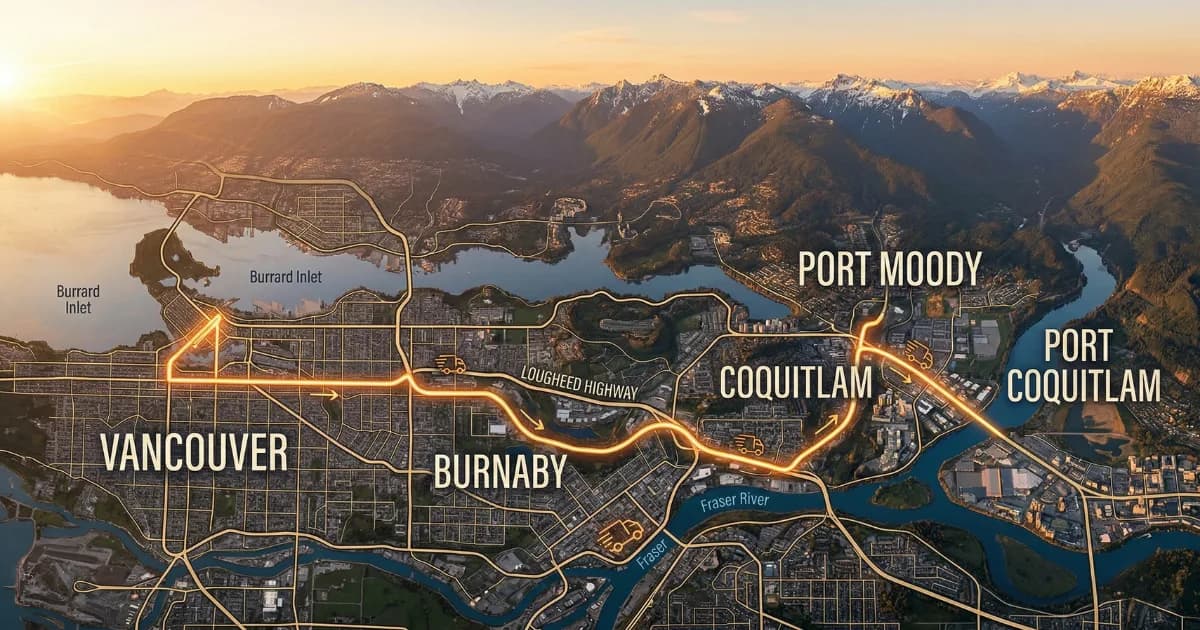
Coquitlam, Port Coquitlam, and Port Moody form one of the fastest-growing family corridors in Metro Vancouver, and after running delivery routes into the Tri-Cities for the past several years, I can tell you the demand for reliable meal delivery here is real and growing. The challenge isn't whether families in Burke Mountain or Inlet Centre want fresh, home-style Asian meals delivered to their door. They absolutely do. The challenge is the 30-to-45-kilometre stretch between our Vancouver kitchen and the residential neighborhoods where these families live, and everything that happens on the roads in between.
The Tri-Cities sit at the eastern edge of Metro Vancouver, connected to the urban core by three main arteries: Highway 1 (the Trans-Canada), Lougheed Highway, and Barnet Highway. Each route has its own traffic personality, and none of them are forgiving during rush hour. A delivery that takes 35 minutes at 10:30 AM can stretch past an hour if you hit the Highway 1 merge at the Brunette Avenue interchange wrong, or if an accident on Barnet Highway near Ioco Road backs everything up to the SFU exit. These aren't hypothetical scenarios. I've sat through both.
What I've built for Tri-Cities delivery is a system that respects these distances rather than pretending they don't exist. Purpose-mapped routes for each of the three municipalities. Timing buffers calibrated to real traffic data, not optimistic GPS estimates. Insulated packaging tested through Vancouver's six-month rain season that keeps food above serving temperature for the full transit window. And honest communication with families about when delivery windows tighten and when we'd rather tell you the truth about timing than make a promise we can't keep.
I'll be straightforward: Tri-Cities delivery is our longest route and our most logistics-intensive coverage zone. But the families out here — young parents in the new developments along Burke Mountain, dual-income households in Port Moody's heritage neighbourhoods, school communities across all three cities — deserve the same quality and reliability we deliver to Burnaby or Downtown Vancouver. That's what we're building toward, and I want to walk you through exactly how it works.
Summary: The Tri-Cities (Coquitlam, Port Coquitlam, Port Moody) represent Metro Vancouver's fastest-growing family corridor, but the 30-45 km distance from our Vancouver kitchen creates real delivery logistics challenges across Highway 1, Lougheed Highway, and Barnet Highway. We've built purpose-mapped routes, calibrated timing buffers, and tested insulated packaging specifically for this extended transit window.
Why the Tri-Cities Are a Growing Family Market
The Tri-Cities aren't the suburban afterthought they were a decade ago. Coquitlam alone has grown past 150,000 residents, with Port Coquitlam and Port Moody adding density through new townhome and condo developments that specifically attract young families priced out of Vancouver and Burnaby[1]. The demographics here tell a clear story: growing Asian populations, school-age children, dual-income households, and a food culture that values authentic home-style cooking but lacks the time to execute it every night.
Burke Mountain in northeast Coquitlam is a case study in this shift. What was forest and undeveloped land ten years ago is now one of the largest new residential communities in Metro Vancouver — thousands of families in townhomes and detached houses, many of them first- or second-generation Asian-Canadian families who want their kids eating the food they grew up with. The same pattern shows up in the Burquitlam corridor along North Road, where high-rise development has brought a wave of younger residents who commute to Burnaby or Vancouver on the SkyTrain and get home too late to cook from scratch.
Port Moody's Inlet Centre has transformed from a quiet village hub into a mid-rise residential zone anchored by the Evergreen Extension of the SkyTrain. Port Coquitlam's Dominion Triangle and Shaughnessy neighbourhoods are filling in with family-oriented housing. All three cities share a common reality: the families moving here want suburban space and school quality, but they're trading proximity to Vancouver's restaurant density and food infrastructure for it. That trade-off creates a genuine gap — and it's the gap we're filling.
According to Statistics Canada 2021 Census data, Coquitlam's population grew 7.7% between 2016 and 2021, significantly outpacing Metro Vancouver's overall growth rate[1]. The visible minority population across the Tri-Cities continues to rise, with Chinese, Korean, and South Asian communities representing substantial shares of the population. These aren't abstract demographic numbers. They translate directly into demand for culturally authentic meal options that generic pizza delivery and DoorDash aggregation simply don't satisfy.
School and Childcare Density
The Tri-Cities are served by School District 43 (Coquitlam), one of the largest in British Columbia, operating over 70 schools across the three municipalities[2]. The kindergarten and daycare landscape is equally dense — licensed childcare facilities dot every major residential area from Westwood Plateau to Port Coquitlam's Mary Hill neighbourhood. This school infrastructure matters for us because it represents concentrated pockets of families with children who need reliable, nutritious meal solutions during the school week.
We currently serve select kindergartens and daycares in the Tri-Cities and are actively expanding those partnerships. The logistics require different handling than our Vancouver or Burnaby school routes — earlier dispatch times, dedicated drivers who know the Tri-Cities road network, and menu packaging designed for the longer transit. I'll detail the specifics in the school section below.
Delivery Routes: Getting Fresh Food From Our Kitchen to Your Tri-Cities Door
The single biggest operational question for Tri-Cities meal delivery is this: how do you maintain food quality across a 35-to-45-minute drive that can stretch to 60+ minutes during rush hour? Here's exactly how we approach it, route by route.
The Three Main Routes
Highway 1 (Trans-Canada) is our primary route to central Coquitlam, Burke Mountain, and Port Coquitlam. When traffic is flowing, it's the fastest option — 30 to 40 minutes off-peak from our kitchen to the Lougheed Highway exit that feeds into Coquitlam's residential core. The bottleneck is the Brunette Avenue interchange where Highway 1 merges with traffic coming off the Grandview Highway connector. During the 3:30-6:30 PM window, that merge point can add 20 to 25 minutes by itself. The Cape Horn section where Highway 1 narrows before the United Boulevard exit is the other pressure point — any incident there cascades backward through Port Coquitlam-bound traffic immediately.
Lougheed Highway runs parallel to Highway 1 but at surface level through Burnaby and into the Burquitlam corridor. It's slower as a baseline because of signal lights through the Burnaby stretch, but it serves as our fallback when Highway 1 is jammed. For deliveries to the Maillardville neighbourhood or Austin Heights in western Coquitlam, Lougheed is often the more direct route regardless of conditions. The North Road intersection where Lougheed meets the Burquitlam SkyTrain corridor is a known congestion point during evening rush.
Barnet Highway connects Burnaby (near the Hastings Street corridor) through the hillside past SFU and drops down into Port Moody. It's our shortest route to Port Moody's Inlet Centre and Heritage Mountain neighbourhoods. The trade-off is that Barnet Highway has two-lane sections between the SFU area and Ioco Road that are highly vulnerable to any single incident — one stalled truck and the entire highway backs up with no alternate lane. When Barnet is clear, it's genuinely the fastest path to Port Moody. When it's not, you're stuck.
How We Choose the Route in Real Time
Our drivers don't commit to a fixed route before departure. Instead:
- Check Google Maps live traffic for all three approaches 10 minutes before leaving the kitchen.
- Review DriveBC alerts for any incidents, construction, or closures on Highway 1, Lougheed, or Barnet.
- Default routing: Highway 1 for Coquitlam centre and Port Coquitlam. Barnet for Port Moody. Lougheed as a fallback for western Coquitlam zones.
- Mid-route rerouting: If conditions change during transit — an accident reported on Highway 1 after departure — drivers switch to Lougheed at the Burnaby exit rather than sitting in standstill.
This real-time adaptability is something platform delivery services cannot replicate. An UberEats driver gets assigned your order, follows whatever route GPS suggests at dispatch, and has no institutional knowledge of which route is failing at 4:45 PM on a Tuesday. Our drivers have run these routes hundreds of times and know exactly when to bail on Highway 1 for Lougheed or vice versa.
Summary: Three routes connect our Vancouver kitchen to the Tri-Cities, each with distinct advantages. Highway 1 is fastest to central Coquitlam and Port Coquitlam off-peak (30-40 min). Barnet Highway is shortest to Port Moody (25-35 min off-peak). Lougheed Highway serves as a reliable fallback. Our drivers select routes in real time based on live traffic conditions and switch mid-transit when needed.
Delivery Zones Within the Tri-Cities
Not all Tri-Cities addresses are created equal from a delivery standpoint. Here's an honest breakdown of how each zone performs.
Coquitlam: Our Primary Tri-Cities Zone
Coquitlam is the largest of the three cities and the most varied in delivery logistics. The municipality stretches from the Burquitlam corridor on its western edge (practically an extension of Burnaby) all the way northeast to Burke Mountain's newest developments.
Burquitlam / Lougheed Corridor — This is our most efficient Coquitlam delivery zone. The Burquitlam area along North Road sits right where Burnaby ends and Coquitlam begins. Delivery times from our kitchen run 30-35 minutes off-peak, making it comparable to our Metrotown runs. The density of new condos and townhomes along the SkyTrain corridor means we can cluster multiple drops in a tight radius.
Coquitlam Centre / Town Centre — The commercial and residential core around Coquitlam Centre mall and the area south toward Como Lake. Delivery times: 35-40 minutes off-peak, 55-65 minutes during rush. This is our bread-and-butter Coquitlam zone — enough residential density for efficient multi-stop runs, straightforward road access off Highway 1.
Westwood Plateau / Eagle Ridge — Higher-elevation neighbourhoods on the north side of Coquitlam, accessed via Pinetree Way or David Avenue. Delivery times add 5-10 minutes over Town Centre because of the climb and winding residential streets. These are established family neighbourhoods with larger homes and a demographic that skews toward families with older school-age children. Orders here tend toward family meal boxes rather than individual bentos.
Burke Mountain — The newest and most distant Coquitlam zone. Burke Mountain sits in the northeast corner, accessed via Coast Meridian Road or the David Avenue extension. Delivery times: 40-50 minutes off-peak, potentially 70+ minutes during rush hour. I'll be honest — Burke Mountain pushes the edge of our delivery window. The food still arrives within our insulation threshold, but there's less margin than I'd like on a bad traffic day. We serve Burke Mountain and are committed to improving our timing there, but families in this zone should order earlier than our standard Coquitlam cutoffs.
Port Moody: Compact and Efficient
Port Moody is the smallest of the three Tri-Cities municipalities, and that works in our favour logistically. The residential areas cluster around three main zones:
Inlet Centre / Moody Centre — The core of Port Moody along St. Johns Street and around the SkyTrain terminus. This is our most efficient Port Moody delivery zone. Barnet Highway drops you right into the neighbourhood, and delivery times run 25-35 minutes off-peak. The mix of new mid-rise condos and established homes creates a strong base of young families and professionals who order regularly.
Heritage Mountain / Heritage Woods — The hillside residential developments above the Port Moody core. Accessed via Heritage Mountain Boulevard off Murray Street, these neighbourhoods add 5-8 minutes over Inlet Centre. Large family homes, predominantly families with school-age children. The roads are well-laid-out and our drivers know the area, so timing is predictable.
Ioco / Anmore Edge — The furthest reach of our Port Moody coverage. Ioco Road runs northeast from Port Moody toward Anmore and Belcarra, and it's a single corridor with no shortcut. We serve the developed portions of Ioco and the neighbourhoods closest to Port Moody proper, but deep Anmore and Belcarra are currently outside our reliable delivery zone. Similar to Deep Cove in North Vancouver — the single-road access makes timing unpredictable during peak hours.
Port Coquitlam: The Eastern Anchor
Port Coquitlam sits east of Coquitlam and south of the Pitt River, accessed primarily via the Lougheed Highway corridor or Highway 1 to the United Boulevard exit.
Downtown PoCo / Shaughnessy — The older residential core of Port Coquitlam along Shaughnessy Street and around the downtown area. Delivery times: 35-45 minutes off-peak. This zone benefits from relatively simple road access once you're off Highway 1 at the Mary Hill Bypass exit.
Dominion Triangle / Citadel Heights — Newer residential developments with a mix of townhomes and single-family homes. These are strong family neighbourhoods with growing demand for delivery services. Timing is comparable to downtown PoCo.
Mary Hill / Riverside — The southeastern edge of Port Coquitlam, closer to the Pitt River. Adds 5-10 minutes over downtown PoCo. Lower density means fewer multi-stop opportunities, so we typically serve this zone as part of a broader PoCo delivery run rather than as standalone drops.
Summary: Coquitlam ranges from the efficient Burquitlam corridor (30-35 min off-peak) to the challenging Burke Mountain zone (40-50 min off-peak). Port Moody benefits from compact geography with Inlet Centre being our fastest Tri-Cities stop (25-35 min via Barnet Highway). Port Coquitlam sits at 35-45 minutes off-peak with straightforward Highway 1 access. Each zone gets customized routing and timing buffers.
Maintaining Freshness Over Longer Distances
The honest reality of Tri-Cities delivery compared to our Downtown Vancouver or Burnaby routes: the food spends more time in transit. A Kitsilano delivery might take 15 minutes from our kitchen. A Burke Mountain delivery takes 40-50 minutes on a good day. That difference matters, and I want to explain exactly how we manage it.
Temperature Management
Our insulated delivery carriers are tested to maintain food above 60 degrees Celsius for approximately 90 minutes from kitchen departure. For context:
- Downtown Vancouver / Burnaby delivery: Food is in the carrier for 15-25 minutes. Massive margin.
- Tri-Cities off-peak delivery: Food is in the carrier for 30-50 minutes. Comfortable margin for all zones except Burke Mountain on a slow day.
- Tri-Cities peak delivery: Food can be in the carrier for 55-75 minutes. This is where we approach the performance threshold, which is why we recommend earlier ordering for rush-hour Tri-Cities delivery.
The carriers are moisture-resistant — critical during Vancouver's October-through-April rain season. The Tri-Cities tend to receive slightly more precipitation than Downtown Vancouver due to their position closer to the Coast Mountains, and rain on Highway 1 or Barnet Highway can slow traffic while simultaneously challenging packaging integrity. We've tested our system through full winter seasons and it holds up, but it's a tighter window than our core routes.
Kitchen Timing Coordination
For Tri-Cities orders, we adjust our kitchen completion timing so that food goes into the carrier at peak temperature right before the driver departs. There's no staging shelf time — the gap between the last wok touch and carrier seal is measured in minutes. This matters more for a 45-minute Tri-Cities transit than for a 15-minute Burnaby run, where even food that sat for 10 minutes before dispatch would arrive well within temperature.
Comparison With Our Closer Delivery Zones
| Delivery Zone | Off-Peak Time | Peak Time | Insulation Margin | Recommended Order-By |
|---|---|---|---|---|
| Downtown Vancouver | 10-15 min | 20-30 min | 75+ min remaining | Standard cutoffs |
| Burnaby / Metrotown | 15-25 min | 30-45 min | 65+ min remaining | Standard cutoffs |
| Burquitlam | 30-35 min | 50-60 min | 55+ min remaining | 4:00 PM for dinner |
| Coquitlam Centre | 35-40 min | 55-65 min | 45+ min remaining | 3:30 PM for dinner |
| Port Moody | 25-35 min | 45-65 min | 55+ min remaining | 4:00 PM for dinner |
| Port Coquitlam | 35-45 min | 55-70 min | 40+ min remaining | 3:30 PM for dinner |
| Burke Mountain | 40-50 min | 65-75+ min | 30+ min remaining | 3:00 PM for dinner |
I include these numbers because I believe families should make informed decisions. We absolutely serve the Tri-Cities and we're proud of the operation we've built. But a Burke Mountain family ordering at 5:30 PM for a 6:15 dinner should know that their food is going to be in transit during the worst traffic window with the least insulation margin. If that same family orders at 3:00 PM, the math changes completely — off-peak traffic, faster transit, food arriving with plenty of thermal headroom.
Summary: Our insulated carriers maintain food above 60 degrees Celsius for 90 minutes, giving comfortable margin for most Tri-Cities zones during off-peak hours. Burke Mountain during rush hour approaches the performance threshold. We coordinate kitchen timing so food enters carriers at peak temperature with no staging delays, and we recommend earlier ordering for outer Tri-Cities zones to maintain quality.
School and Kindergarten Partnerships in the Tri-Cities
The Tri-Cities school landscape is massive. School District 43 (Coquitlam) serves all three municipalities and operates more than 70 schools with over 32,000 students[2]. The kindergarten and licensed daycare density is equally significant, with facilities concentrated in the family-heavy residential zones of Westwood Plateau, Burke Mountain, Port Moody's Heritage Mountain, and Port Coquitlam's Shaughnessy area.
What Tri-Cities School Partnerships Require
Working with Tri-Cities schools and daycares requires a different logistics model than our Vancouver or Burnaby partnerships:
Earlier dispatch times. Our Vancouver-based school deliveries can leave the kitchen at 10:00-10:30 AM for an 11:30 arrival. Tri-Cities school deliveries need to depart by 9:30 AM to guarantee arrival before the lunch period starts, with buffer for Highway 1 variability.
Menu packaging for extended transit. School meals that travel 40+ minutes need packaging that maintains both temperature and presentation. A bento that arrives with the rice shifted to one side and sauce leaked across the divider is a failed delivery, even if the food temperature is fine. We've refined our school-specific packaging for the longer Tri-Cities transit — stiffer containers, more secure lids, sauce portions separated until arrival.
SD43 calendar alignment. School District 43 follows its own professional development day schedule, holiday calendar, and early dismissal pattern. We sync our delivery schedule to avoid wasted runs on Pro-D days or shortened school days where lunch service isn't needed.
Dietary compliance documentation. Every kindergarten and daycare partnership starts with a full allergen protocol, ingredient sourcing documentation, and food safety certification package. Tri-Cities facilities have the same requirements as Vancouver ones — we provide this proactively rather than waiting to be asked.
Age-appropriate portioning. Kindergarten portions are fundamentally different from elementary school portions, which are different from middle school portions. We've calibrated Tri-Cities school serving sizes based on direct feedback from partner facilities across SD43, not by scaling down adult meal sizes.
Current and Prospective Coverage
We currently serve select kindergartens and childcare facilities in the Coquitlam and Port Moody areas. We're actively expanding Tri-Cities school partnerships and are open to conversations with any SD43 school administration or licensed childcare facility interested in reliable, nutritious Asian meal options for their students.
For school administrators reading this: the initial conversation is straightforward. We walk through your facility's dietary requirements, scheduling needs, student headcount, and budget. We provide a tasting session for your staff to evaluate the food firsthand. And we give you honest timing commitments based on your school's specific location within the Tri-Cities — because a Burquitlam facility and a Burke Mountain facility will have different delivery windows, and you deserve to know that upfront.
Summary: School District 43 serves 32,000+ students across 70+ Tri-Cities schools, creating significant demand for school meal delivery. Our partnerships require earlier dispatch (9:30 AM), transit-optimized packaging, SD43 calendar alignment, and age-appropriate portioning. We currently serve select facilities and are actively expanding across all three municipalities.
Weekend Family Meal Delivery
Weekend delivery to the Tri-Cities is genuinely different from weekday service — and in some ways, it's better.
Highway 1 and Barnet Highway traffic patterns shift significantly on Saturdays and Sundays. The weekday commuter crush disappears, but recreational traffic can spike unpredictably. Families heading to Golden Ears Provincial Park via the Lougheed Highway or cyclists using the Traboulay PoCo Trail route create different congestion patterns, concentrated more on Saturday mornings than the weekday evening rush.
Saturday and Sunday Delivery Windows
We offer expanded delivery windows on weekends for Tri-Cities families:
- Saturday: Mid-morning through early afternoon (10:00 AM - 2:00 PM). Weekend brunch and lunch orders benefit from generally lighter traffic across all three routes.
- Sunday: Similar window, with slightly lighter traffic overall. Sunday evenings can see return traffic from recreational areas that affects the Highway 1 corridor, so we recommend earlier windows for Sunday dinner orders.
What Tri-Cities Families Typically Order on Weekends
The weekend order profile for Tri-Cities families is different from weekday patterns:
- Family meal boxes are the most popular weekend item — a complete dinner for four with variety, starting at $39.99. These families are tired from a week of juggling school pickups, commutes, and activities. A Saturday or Sunday dinner that's handled gives them back an evening.
- Party trays and platters for weekend gatherings. Port Moody and Coquitlam have strong community cultures — kids' birthday parties, neighbourhood get-togethers, sports team celebrations. Our Dim Sum Party Tray (40 pieces, $79.99) and BBQ Platter ($99.99) are popular for these.
- Meal-prep orders — some Tri-Cities families order multiple meal boxes on Saturday to cover the early part of the following week. This is a smart approach that reduces weeknight delivery pressure and takes advantage of weekend traffic windows.
Minimum Orders for Weekend Tri-Cities Delivery
For weekend Tri-Cities delivery, we apply a minimum order of $40 — which most family orders naturally exceed. This threshold ensures the delivery run is economically viable given the distance, and most families ordering a family meal box or party tray clear it without thinking about it.
Single bento orders to the Tri-Cities on weekends aren't practical from a logistics standpoint — the 30-to-50-minute round trip for a single $13 item doesn't work for us or for you (by the time it arrives, freshness is better served by a closer restaurant). We're honest about that trade-off. For individual meals, we'd recommend checking out local Tri-Cities Asian restaurants or picking up from us if you're passing through Burnaby.
Summary: Weekend Tri-Cities delivery benefits from lighter traffic, with expanded 10:00 AM - 2:00 PM windows on both Saturday and Sunday. Family meal boxes, party trays, and meal-prep batch orders dominate weekend demand. A $40 minimum order applies for Tri-Cities weekend delivery, naturally met by most family-sized orders.
How the Tri-Cities Compare to Our Other Delivery Zones
I want to be transparent about where Tri-Cities delivery sits relative to our closer zones, because families considering our service deserve the full picture.
What Works Well
Route consistency. Unlike North Vancouver, where bridge closures can completely cut off access, the Tri-Cities always have multiple route options. If Highway 1 is jammed, Lougheed or Barnet provides an alternative. That redundancy means we've never had a Tri-Cities delivery cancelled due to access — delayed, yes, but never cancelled.
Weekend efficiency. The Tri-Cities are genuinely easier to serve on weekends than North Vancouver. No bridge toll, no lane-reversal schedules, no single-point-of-failure crossing. Weekend family delivery to the Tri-Cities is one of our smoothest operations.
Growing density. Every year, the Tri-Cities get denser — more families in new developments, more multi-stop delivery opportunities per run. This is a route that's getting more efficient over time as the population grows, which is the opposite of the North Shore where geography is fixed.
Where We're Still Improving
Burke Mountain timing. This is our tightest delivery window in the entire Metro Vancouver coverage. We serve Burke Mountain and we're committed to it, but I'd be dishonest if I said the timing margin there is as comfortable as Burnaby or even central Coquitlam. We're actively evaluating solutions — including the possibility of a Tri-Cities staging point that would cut transit times for the furthest zones — but nothing is in place yet.
Peak-hour predictability. The Highway 1 corridor through Burnaby and into Coquitlam is one of the most congested stretches in Metro Vancouver. During the 4:00-6:30 PM window, delivery times to the Tri-Cities have higher variability than any of our other zones. We buffer for this, but families should expect a wider delivery window during rush hour compared to what we offer in Burnaby.
Single-order economics. The distance makes individual bento delivery to the Tri-Cities less economical than our closer zones. We've set minimum orders to keep the service sustainable, but families who regularly order single meals would be better served by local options or pickup.
Summary: Tri-Cities delivery benefits from route redundancy (three route options vs. North Vancouver's two bridges) and improving density as new residential developments fill in. Burke Mountain remains our tightest timing zone, and peak-hour variability on Highway 1 is higher than our closer delivery areas. We're transparent about these trade-offs so families can make informed decisions.
Pricing and Minimum Orders for Tri-Cities Delivery
We do not charge a Tri-Cities distance premium on our standard menu pricing. Your bento boxes, family meal boxes, and party trays cost the same whether they're going to a Kitsilano apartment or a Port Coquitlam townhome.
Standard Menu Pricing
- Signature bento boxes: $11.99-$15.99 (Mapo Tofu, Teriyaki Chicken, Braised Pork Belly, Grilled Salmon)
- Family meal boxes: Starting at $39.99 for a family of four
- Party trays: $79.99 (Dim Sum, 40 pieces) to $149.99 (Noodle Station, 20 servings)
- School group meal boxes: Custom pricing based on headcount and menu selection
Minimum Order Requirements
To keep Tri-Cities delivery economically viable for everyone involved:
- Weekday delivery: $50 minimum order. A family of four ordering two to three bento boxes plus a shared side typically clears this naturally.
- Weekend delivery: $40 minimum order. A single family meal box meets this threshold.
- School and kindergarten partnerships: Custom minimums negotiated per facility based on headcount and delivery frequency.
- Event and party catering: No separate minimum — party tray orders inherently exceed the threshold.
Why These Minimums Exist (And Why I'm Transparent About It)
A round trip from our Vancouver kitchen to central Coquitlam and back takes approximately 70-90 minutes of driver time, plus fuel and vehicle wear. For a single $12 bento order, that math simply doesn't work — not for us, and not for you, because the food would spend more time in a delivery vehicle than it would on your dinner table. The minimums ensure that every Tri-Cities delivery run is worth the driver's time and that we can maintain the quality standards families expect.
We absorb the route cost into our planning by clustering Tri-Cities deliveries — multiple stops per run, coordinated timing, efficient zone sequencing. That's how we keep standard menu pricing without adding a distance surcharge. But it requires sufficient order volume per run to pencil out.
Summary: No distance premium for Tri-Cities delivery. Standard menu pricing applies across all three municipalities. Weekday minimum order is $50, weekend is $40. These thresholds reflect the 70-90-minute round-trip driver time and ensure delivery quality remains sustainable. We absorb route costs through multi-stop delivery clustering.
Book a Tasting or Get in Touch
If you're a Tri-Cities family wondering whether meal delivery from a Vancouver kitchen can actually work for you — whether the food arrives hot, whether the timing is reliable, whether it tastes like what you'd want your family eating — I'd like to show you rather than just tell you.
Book a complimentary tasting to try our menu with no commitment. We'll walk you through exactly how delivery to your specific Tri-Cities neighbourhood works, including realistic timing and the best order windows for your zone: https://thestormcafe.com/tasting
Or contact us directly to discuss your family's needs — whether it's weeknight dinners, school lunch partnerships, weekend family meal boxes, or event catering anywhere in Coquitlam, Port Coquitlam, or Port Moody: https://thestormcafe.com/contact
Summary: Book a complimentary tasting at thestormcafe.com/tasting to sample our menu and learn exactly how delivery works for your specific Tri-Cities neighbourhood. Or contact us at thestormcafe.com/contact to discuss weeknight family dinners, school partnerships, or event catering across Coquitlam, Port Coquitlam, and Port Moody.
References
[1]: Statistics Canada, "Census Profile, 2021 Census of Population — Coquitlam, City," 2022. Population growth data, demographic composition, and visible minority statistics for Coquitlam and surrounding municipalities. https://www12.statcan.gc.ca/census-recensement/2021/dp-pd/prof/index.cfm?Lang=E
[2]: School District 43 (Coquitlam), "About SD43," 2026. District overview covering 70+ schools across Coquitlam, Port Coquitlam, Port Moody, Anmore, and Belcarra, serving 32,000+ students. https://www.sd43.bc.ca/Pages/default.aspx
[3]: DriveBC, "Lower Mainland Highway Conditions," 2026. Real-time traffic conditions, incidents, and construction schedules for Highway 1, Lougheed Highway, and Barnet Highway through the Tri-Cities corridor. https://www.drivebc.ca/
[4]: Flavory Food, "Menu — Flavory Food," 2026. Bento boxes: Teriyaki Chicken ($12.99), Braised Pork Belly ($13.99), Mapo Tofu ($11.99), Grilled Salmon ($15.99). Service area includes Coquitlam, Port Coquitlam, and Port Moody. 500+ meals per week, 4.9 customer rating. https://thestormcafe.com/menu
[5]: TransLink, "SkyTrain Evergreen Extension," 2026. Evergreen Extension connecting Coquitlam to the broader SkyTrain network, impacting residential growth and commuter patterns across the Tri-Cities. https://www.translink.ca/
[6]: City of Coquitlam, "Coquitlam Community Profile," 2026. Demographic data, neighbourhood profiles, and development statistics for Coquitlam's residential areas including Burke Mountain and Burquitlam. https://www.coquitlam.ca/
Frequently Asked Questions
Do you actually deliver to Coquitlam and the Tri-Cities, or is it just listed on your coverage map?
We genuinely deliver to all three Tri-Cities municipalities — Coquitlam, Port Coquitlam, and Port Moody. Our drivers run dedicated Tri-Cities routes daily using three approach roads: Highway 1, Lougheed Highway, and Barnet Highway. We select routes in real time based on live traffic conditions and switch mid-transit when needed. This is fundamentally different from platform services that assign a random driver who may have never navigated the Brunette interchange during rush hour. Tri-Cities is our longest delivery zone, and we've built purpose-specific logistics for it rather than treating it as an afterthought.
How do you keep food fresh during the longer drive to the Tri-Cities?
Our insulated delivery carriers maintain food above 60 degrees Celsius for approximately 90 minutes from kitchen departure. For most Tri-Cities zones, transit time is 30-50 minutes off-peak, leaving comfortable thermal margin. We coordinate kitchen timing so food enters carriers at peak temperature with no staging delay. For outer zones like Burke Mountain during rush hour, we recommend earlier ordering to avoid the 65-75-minute transit window where insulation margin gets tighter. The carriers are also moisture-resistant, critical during Vancouver's October-through-April rain season.
What are the minimum order requirements for Tri-Cities delivery?
Weekday delivery requires a $50 minimum order, and weekend delivery requires $40. A family of four ordering two to three bento boxes plus a shared side typically exceeds the weekday threshold naturally, and a single family meal box ($39.99+) meets the weekend minimum. These thresholds exist because a round trip from our kitchen to the Tri-Cities takes 70-90 minutes of driver time. We keep standard menu pricing without a distance surcharge by clustering multiple Tri-Cities deliveries per run, but each run needs sufficient volume to be sustainable.
Can you deliver to Burke Mountain in northeast Coquitlam?
Yes, we deliver to Burke Mountain, but I want to be honest about the specifics. Burke Mountain is our furthest delivery zone in the Tri-Cities, with off-peak transit times of 40-50 minutes and rush-hour times that can exceed 70 minutes. We recommend Burke Mountain families order by 3:00 PM for dinner delivery to ensure food arrives within our quality standards. The insulation margin is tighter here than in central Coquitlam or Port Moody, so earlier ordering makes a meaningful difference in food temperature on arrival.
Do you serve schools and kindergartens in the Tri-Cities?
We currently serve select kindergartens and childcare facilities in Coquitlam and Port Moody, and we're actively expanding across the Tri-Cities. School partnerships require earlier dispatch times than our standard routes — our trucks leave by 9:30 AM to guarantee arrival before lunch periods begin. We align with the School District 43 calendar, provide dietary compliance documentation, and size portions specifically for each age group. If you're a school administrator or daycare operator interested in discussing a partnership, contact us for a staff tasting session and logistics walkthrough specific to your facility's location.
Related Articles
Vegetarian and Vegan Asian Meals: Our Plant-Based Menu
Explore The Storm Cafe's vegetarian and vegan Asian menu: tofu, tempeh, mushroom dishes, and veggie
Vancouver School Lunch Delivery: Coverage Map and Zones
Flavory Food's school lunch delivery coverage across Greater Vancouver. Zone-by-zone guide with driv
Same-Day Order Changes: Our Flexibility Policy Explained
Flavory Food explains our same-day order change policy for Vancouver families, kindergartens, and sc
Want to taste our meals?
Book a free tasting and let our fresh ingredients speak for themselves.
Free Tasting